Skip to content

Posts tagged ‘advocacy’

We Deliver? How about we make it a better delivery?

permission from CartoonStock

permission from CartoonStock

Our Maternity Services

Need Help!

The Maternal Child care delivery system in this country as a whole needs vast improvement. All of these 10 steps as well as the 10 steps to ensure optimal successful  breastfeeding are very important.

These items are sadly grossly misconstrued or ignored by many facilities offering maternity services in this country. I have been having the same discussions and occasional arguments with co-workers  lately on this battle of the newborn baby staying in the moms room overnight!!! I know~ it is a no brainer to those of you who read, research and understand. Many of my co-workers still defend their philosophy that the baby needs to come into the nursery at night so the mom can sleep!!  Many argue with me about labor positions and inductions!! AARRGGHH! I won’t get into our details right now…….

What I have here for you today is NOT new info but I recently reviewed it again as I was searching for evidence to back my discussions with staff. If you haven’t placed this information in your workplace to nudge some resistant peers, I urge you to do so!

This document : THE COALITION FOR IMPROVING MATERNITY SERVICES:
EVIDENCE BASIS FOR THE TEN STEPS OF MOTHER-FRIENDLY CARE
can show you research studies or data which support the ten steps below.

The 10 steps for Mother-Friendly Care from CIMS {Coalition for Improving Maternity Services} taken from their website…..are:

Ten Steps of the Mother-Friendly Childbirth Initiative
For Mother-Friendly Hospitals, Birth Centers,* and Home Birth Services

To receive CIMS designation as “mother-friendly,” a hospital, birth center, or home birth service must carry out the above philosophical principles by fulfilling the Ten Steps of Mother-Friendly Care.

A mother-friendly hospital, birth center, or home birth service:

  1. Offers all birthing mothers:
    • Unrestricted access to the birth companions of her choice, including fathers, partners, children, family members, and friends;
    • Unrestricted access to continuous emotional and physical support from a skilled woman—for example, a doula,* or labor-support professional;
    • Access to professional midwifery care.
  2. Provides accurate descriptive and statistical information to the public about its practices and procedures for birth care, including measures of interventions and outcomes.
  3. Provides culturally competent care—that is, care that is sensitive and responsive to the specific beliefs, values, and customs of the mother’s ethnicity and religion.
  4. Provides the birthing woman with the freedom to walk, move about, and assume the positions of her choice during labor and birth (unless restriction is specifically required to correct a complication), and discourages the use of the lithotomy (flat on back with legs elevated) position.
  5. Has clearly defined policies and procedures for:
    • collaborating and consulting throughout the perinatal period with other maternity services, including communicating with the original caregiver when transfer from one birth site to another is necessary;
    • linking the mother and baby to appropriate community resources, including prenatal and post-discharge follow-up and breastfeeding support.
  6. Does not routinely employ practices and procedures that are unsupported by scientific evidence, including but not limited to the following:
    • shaving;
    • enemas;
    • IVs (intravenous drip);
    • withholding nourishment or water;
    • early rupture of membranes*;
    • electronic fetal monitoring;
    • Has an induction* rate of 10% or less;†
    • Has an episiotomy* rate of 20% or less, with a goal of 5% or less;
    • Has a total cesarean rate of 10% or less in community hospitals, and 15% or less in tertiary care (high-risk) hospitals;
    • Has a VBAC (vaginal birth after cesarean) rate of 60% or more with a goal of 75% or more.
  7. other interventions are limited as follows:

  8. Educates staff in non-drug methods of pain relief, and does not promote the use of analgesic or anesthetic drugs not specifically required to correct a complication.
  9. Encourages all mothers and families, including those with sick or premature newborns or infants with congenital problems, to touch, hold, breastfeed, and care for their babies to the extent compatible with their conditions.
  10. Discourages non-religious circumcision of the newborn.
  11. Strives to achieve the WHO-UNICEF “Ten Steps of the Baby-Friendly Hospital Initiative” to promote successful breastfeeding:
    1. Have a written breastfeeding policy that is routinely communicated to all health care staff;
    2. Train all health care staff in skills necessary to implement this policy;
    3. Inform all pregnant women about the benefits and management of breastfeeding;
    4. Help mothers initiate breastfeeding within a half-hour of birth;
    5. Show mothers how to breastfeed and how to maintain lactation even if they should be separated from their infants;
    6. Give newborn infants no food or drink other than breast milk unless medically indicated;
    7. Practice rooming in: allow mothers and infants to remain together 24 hours a day;
    8. Encourage breastfeeding on demand;
    9. Give no artificial teat or pacifiers (also called dummies or soothers) to breastfeeding infants;
    10. Foster the establishment of breastfeeding support groups and refer mothers to them on discharge from hospitals or clinics

† This criterion is presently under review.

I endorse these steps. You can visit their website to also endorse.

Kathy from Woman to Woman Childbirth Education wrote about the CIMS press release on the Need for Transparency regarding the rising C/S rates. Excellent information is discussed here by the CIMS and I enjoyed the discussion between Kathy and RealityRounds.

I also would urge you all to visit and give information to The Birth Survey.

How is your birth place measuring up to these initiatives?

Let’s all continue to make this a better world

in which to give birth!!

**ROAR** on Breastfeeding Guilt

10_Lioness-with-Cub-Feeding

(Image found at Google Images)

**ROAR**

The Mommy Wars over feeding babies continue..I guess it won’t ever be truly over. I’ve been following a discussion over at NursingBirth on  “Why Educating Our patients is a Professional Responsibility and Not about Guilt.”

I thank her for quoting me and including thoughts I wrote on what I have learned over the years talking to, educating and helping mothers.

I have re-posted this earlier segment  “Breastfeeding, Bottle-feeding and Somewhere In-between… Why the Guilt?” This post is about what I have learned speaking from a professional point of view. As a professional, it is inappropriate for any of us to imply directly or indirectly to any mother trying to make feeding choices that breastfeeding and formula feeding are equal.  They are not. Human milk is the superior species-specific food for Human infants. The recommended feeding hierarchy from the experts (AAP,CDC, WHO) is Breastfeeding, expressed mother’s milk, expressed donor milk then properly prepared infant formula. That’s why NursingBirth’s post is so important to understand. Reading the comments……

There are STILL moms out there confusing the issue.

All or most of this discussion is NOT directed at any mother who tried to breastfeed under any circumstance and wasn’t able to at all or wasn’t able to fulfill her individual goals. I applaud all your efforts for trying to give your baby the best food you could. I am so sorry that you experienced the difficulties you have. Your situation is not what this discussion is about. I think it’s very possible that advocates and some professionals lack sufficient skills to help you deal with the loss of a breastfeeding relationship. If breastfeeding is important to you then you would truly go through a grieving process and guilt would most likely come into play somewhere along the line. We do that to ourselves a lot as women anyway. I did personally experience that guilt. I had wanted to breastfeed my last baby for a full year and was unable to because of personal health problems. I had a lot of guilt. This discussion is NOT about these situations. Let’s stop making it about that. Please!

This mommy war guilt discussion as I see it is one where a mother who chooses to formula feed defends her choice and lays claim that those who are promoting or advocating breastfeeding make her feel guilty.

Guilt comes from within an individual if they feel they haven’t done what they “should” or wanted to. Guilt is a very strong emotion. NursingBirth has a great description of guilt as does The Feminist Breeder in “Mommy Guilt- Its all about Perspective.” It would be a good idea for guilt-ridden moms to read these articles. Those professionals or advocates who I have mentioned here or in my re-post are trying to do a good job of making sure people have the information to make educated decisions about health care issues.  Any professional who intentionally tries to make a mother feel guilty isn’t being very professional. If there is an advocate out there continually finding moms feeling guilty, perhaps you should change how you deliver the message. I said in this earlier post about how one single word can make a difference:

“She needs to be comfortable and confident with her decision. Perhaps her guilt comes from how one single little word or sentence was said, even if what was said is accurate and true. Perhaps her guilt is coming from her own internal struggles. I don’t know.  She needs to come to terms with that herself,  and not punish herself and or publicly criticize the advocates saying they are causing the guilt.  Although there are some very zealous advocates out there, I feel in my heart they are not trying to make any individual mother feel guilty. I read a comment from a mom somewhere that said something like… “perhaps if moms knew it wasn’t all or nothing, maybe more would try breastfeeding.”  My first thought was..why do they even think that..are there really mom’s who feel it has to be all or nothing? Is this causing the guilt because they don’t think they can breastfeed exclusively for the first 6 months as the experts recommend??”

None of this changes the facts. Like it or not, breastfeeding is and will continue to be a major Public health Issue to the point of a public health crisis! As professionals and advocates, our work is not finished. I think sometimes that those speaking out against advocates get in the way of facts and put their personal opinions or views out in front and totally distort the issue. I read on someones blog this week (TFB) a great quote by Daniel P. Moynihan: “You are entitled to your own opinion, but not your own facts.” and I loved it!

According to this article from the American Journal of Public Health:

“Today’s medical community recognizes what their
predecessors knew a century ago—that the
American propensity to shun human milk is
a public health problem and should
be exposed as such.”

I am still going to promote breastfeeding. I am still going to provide appropriate factual information to the mothers in my care and support whatever feeding decision they make. I will never be pushy. I will gently encourage those on the fence to give breastfeeding a try. I always support the mother.

But more people need to talk about the importance of breastfeeding.

Because it is

Important.

Don’t be guilty

Stop it

*ROAR*


Repost~ The Guilt trip~ Breastfeeding, Bottle-Feeding and…. Somewhere In-between…. Why the Guilt?

There has been so much discussion circulating in the blogosphere right now about breastfeeding.  I thought I’d add my 2 cents because….I have an opinion and….. I have just a little experience in this field both in study (2 year Lactation course, IBCLC for 10 years, current CLC) and in practice (35 years).

I thought I knew so much in 1988 after nursing 3 babies and assisting others for nearly 15 years. I actually thought I could just take the IBLCE exam based on my experience!

I was so ignorant and naïve!

I started to talk to some IBCLC’s and my eyes were opened wide to the real world. Up to that point, at that time, (I sadly and guiltily admit) I had no idea about the volume of study and research in the field of lactation. I had NO idea just how wrong we were doing things at my hospital.

I launched into a lactation course, soaking up all I could, 3 years of study preparing for certification. I set out to change the world… at least my world. I wrote big proposals for the hospital. I applied for grants to fund a lactation program. I developed education competencies for the staff. I started breastfeeding classes. I thought everybody shared my passion, that they too would want to learn …. because I was right!!

Instead I was the target of all the boob jokes you could think of and I had almost no support. My ideas were rejected left and right.

Long story short…it took me a long time to come to terms with accepting small changes, taking baby steps…..continuing to do the best job I could with each mother-baby couple and to keep a positive outlook. I needed to remain realistic about how much I could actually accomplish one step at a time. Slowly I began to have people under my wing trying to learn. Yeah!

I learned a lot about how to approach physicians, co-workers, managers and most of all …. mothers.

I am not an expert in journalism or critical analysis so this is my opinion of what is going on right now.

There have been some irresponsible journalists, those who have a bigger platform than most of us, writing negatively about something they have not studied or truly researched. They are expressing their opinion and including an emotional component which has, in my opinion, gotten the reaction they hoped for from breastfeeding advocates as well as those who concur with the authors. More hits, more readers. I feel they have twisted the facts to benefit or support a point they want to make. I read some of them.. other’s I really just scanned then brushed off so I don’t know everything that’s been said. On the positive side, these articles possibly give us a larger platform to provide correct information to a larger public in reply.

I read a lot of blogs and I really respect and admire all the research that many breastfeeding advocates put into their fabulous posts. These are educated women who are trying to provide current accurate information! (@phdinparenting, @bfmom, @MommyNews , @JakeAryehMarcus, @blacktating ,@AmberStrocel, and so many more). I applaud their passion and breastfeeding advocacy. They are doing a very important job. Breastfeeding IS very important and deserves advocacy, protection and support! There are still large scores of women out there making choices with only tiny bits of information, who really do not know the important benefits of breastfeeding. It is because of this, and because we still haven’t met the US Dept HHS Healthy People Goals for 2010, that breastfeeding advocacy needs to continue. I have been there, advocating in a time where I faced great adversity and a lot of negativity. I am bothered that it still exists…and exists now in so many new ways.

I am more disturbed that some mother’s out there are upset. I always try to understand just WHY a mom feels guilty if she chooses to formula feed or do some combination of formula and breastfeeding. I always hope she’s made her choice with good information and that it is her own true choice. Then good for her! I am not to judge. She needs to be comfortable and confident with her decision. Perhaps her guilt comes from how one single little word or sentence was said, even if what was said is accurate and true. Perhaps her guilt is coming from her own internal struggles. I don’t know.  She needs to come to terms with that herself,  and not punish herself and or publicly criticize the advocates saying they are causing the guilt.  Although there are some very zealous advocates out there, I feel in my heart they are not trying to make any individual mother feel guilty. I read a comment from a mom somewhere that said something like… “perhaps if moms knew it wasn’t all or nothing, maybe more would try breastfeeding.”  My first thought was..why do they even think that..are there really mom’s who feel it has to be all or nothing? Is this causing the guilt because they don’t think they can breastfeed exclusively for the first 6 months as the experts recommend??

Over the years, I have learned this:

  • It is inappropriate for a health care professional to indicate to a mother directly or indirectly that formula feeding and breastfeeding are equal. Human breast milk is the superior food for human infants. Properly prepared infant formula is an acceptable substitute for those who cannot or choose not to breastfeed.
  • The first approach is probably the number one factor in gaining a mother’s interest in what you have to say.
  • The education process to a mother needs to be in small doses, sensitive to her unique learning abilities, her cultural beliefs and practices and most importantly, her choices and individual breastfeeding goals.
  • With that in mind, try to provide her with the information she needs to make her decision.
  • Never overestimate a mother’s desire to breastfeed her infant.
  • Never underestimate a mother’s desire to breastfeed her infant.
  • Listen to the mother; help her define her true desires and goals.
  • Many times, the first question she asks may not be what she really wants to ask.
  • The mother’s individual breastfeeding goals, how she defines them, how important they are to her and how she relates them to her actual breastfeeding experience all help define how she measures success.
  • Support the mother, support the mother, and support the mother.

Here are the top 3 responses to the feeding choice question pertaining to breastfeeding at my facility on admission:

  • “Breast and Bottle”
  • “I’m going to do both”
  • “I’m going to ‘try’ to breastfeed”

To each of these I respond very positively with something like… “Great! Tell me what you’ve learned about breastfeeding.”     I will then ask the mom a few questions to somehow find out her true wishes.

Then I say  “We will support and honor however you wish to feed your baby.  I’d like to give you some information so you can really understand and then tell us what you’d like to do.”

I explain some things,  i.e.: how the milk production works, the importance of early feeds etc.. and how formula introduced at that time could  interfere with the process of production, the baby’s ability to latch properly and so on… I usually end with..”We usually recommend to  focus on breastfeeding for now and then offer bottles later after milk supply is established if that is how you’d still like to manage feeding”. ETC…ETC….  Here’s what I then see:

  • There have been so many mom’s who — after a little  bit of information decide they would like to focus on breastfeeding. There have been many who totally fell in love with it.
  • There have also been many who really didn’t want to breastfeed after one single feeding.
  • There are many many still that like to breastfeed and bottle feed in combination right from the start. If they have the right info and understand how things may progress… I still say “Good for you!”
  • I have seen many continue that way for months and they are very happy with that.
  • I’ve seen many mom’s “partially” ( I don’t like to say it that way) breastfeed and feel very proud. I say “good for you!”  They don’t think of it in terms of “exclusive” or “partial”… It’s more like any breast at all…. is breastfeeding vs. no breastfeeding at all.
  • There have been many who also never wanted to try until all of a sudden they see milk leaking!
  • I’ve worked with mom’s where I can see tremendous improvement in her situation, I think she’s going to keep going…but she decides to totally quit. I simply praise her for all her efforts and help her feel proud of herself.
  • I’ve worked with mom’s who have hardly put forth any effort to overcome small obstacles, I think they will probably quit outright… Then..I find out they are the ones exclusively breastfeeding down the road.

I got a comment from a breastfeeding mom @TheFeministBreeder that I absolutely have to share. She describes her own experience in the full comment and on her new blog post.  She comments:

“Yes, I think that’s the most important part – informing a mother of any and ALL benefits/risks to supplementing, and helping them work through the option they choose.  But to tell a mother to supplement without explaining that it could undermine her efforts is just plain mean.  And too many medpros are doing it.  I’m glad there are more nurses like you who will give out the real information to empower a woman to make her own choice.  My smart friend always says ‘It’s not really a choice if you don’t have all the information.’ “

For those mom’s really trying to breastfeed and struggling, there’s more than I can say right here to cover that. I’m sorry for your struggles and hope it gets easier for you. It is important to have a skilled competent support person assisting you who listens thoughtfully and helps you get to the root of your problem… and helps you define and realize your goals. If you are experiencing guilt from your struggles or from not being able to fulfill your goals, desires to breastfeed….I think that kind of guilt is different from what I’m trying to discuss here. I am not a an expert on that. It is valuable to get the best help out there that you can as soon as possible.

I’m adding this after reading some comments on other blogs.. When approaching a mom to observe or assist with the latch process…. Permission is a must! I ALWAYS ask the mother if she would like any assistance with the latch or if  I may observe how well her baby is latching….. If that answer is yes… The next question is ALWAYS.. May I touch your breast? (if that needs to part of the process). I prefer to help moms by having the mom and BABY do the latch. I try to keep my hands out of it.  All nurses and LC’s should practice this. I am sorry for the mom’s who aren’t asked permission to be helped or touched.  😦

One of my favorite things I like to say to any breastfeeding mom is:

“Try not to make any final decision when it’s dark outside”.

On another note, regarding some reader comments on various blogs about public breastfeeding, a skimpy bikini or the bathing-suit issue of a favorite sports magazine show more skin in a provocative, sexy way than any mom breastfeeding. Even the movie stars in their gowns with plunging necklines are showing almost the entire breast! Somehow, that is OK. There are volumes of video footage and photos all over the place… even on billboards. It is sad that the public opinion of a baby breastfeeding (the most natural way for him to eat) is something that should be done in private … yet young girls are encouraged by media to bare more and more skin. Of course being discreet while feeding is important, but I can assure you, most girls in a tiny bikini are thinking more about “tacky exhibitionist behavior” than a mother breastfeeding her baby. Why aren’t law-makers focusing on any of that?

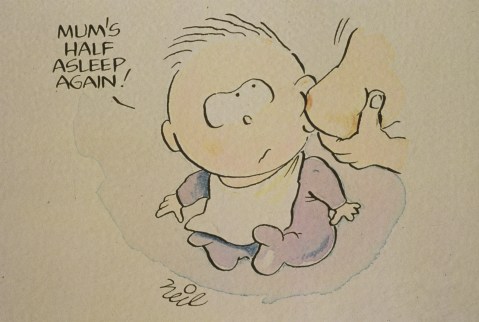
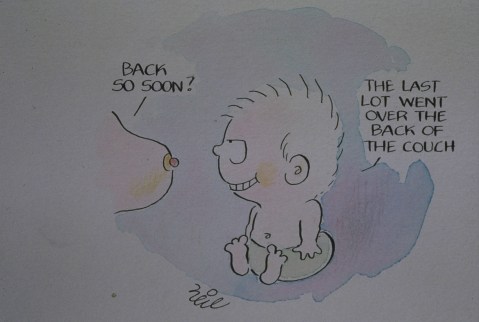
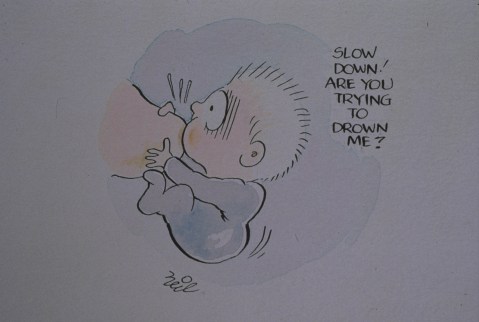
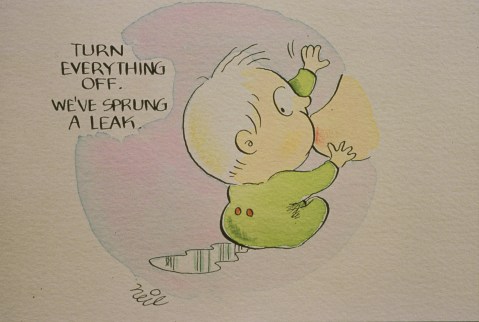
More Breastfeeding Cartoons ~ not #BAD09

I missed the Wordless Wednesday

I have nothing for the Blog Action Day 09

Instead, I’ll provide a little humor today

More Breastfeeding would help the planet anyway!

More Breastfeeding Cartoons by Neil

Enjoy!

10 6 09 031

10 6 09 039

10 6 09 015

10 6 09 057

Webinar~ WHO CODE ~ “The Code, Companies, and LC’s”

This is a reprint of an email invite I received today and wished to share with all those interested.

Brought to you by the USLCA

ON

Wednesday October 14th 2009

United States Lactation Consultant Association

“The Code, Companies, and LC’s” by Marsha Walker

Marsha Walker
Participants will be able to describe the LC’s manufacturing or distributing products within the scope of the Code.
Participants will be able to discuss the elements of the WHO Code as they relate to companies that manufacture or distribute products covered within the scope of the Code.The Code within lactation consultants practice.  LC and ethical Practice within the Code.

  • Use of company products
  • Use of educational materials
  • Exhibiting at conference
  • Attending company sponsored education programs
  • Accepting meals or free items

How does a company meet its obligations under the code

  • Company websites
  • What violates the Code and what does not
  • Pictures-where and how are they acceptable
  • Idealizing language
  • Marketing vs Selling


Course Details
60 Min program
1 E Cerp Awarded for participating
(Certificates are emailed to attendees)

Price:
USLCA Members $20,   Non-members $30, Groups 2-10 $45, 10 or more $65

Click here to sign up “The Code, Companies, And LC’s”

Here’s how to sign up for a USLCA Webinar1. Down load the sign up sheet for the appropriate webinar.Click here for list of scheduled webinars.

2. Submit your sign up sheet and payment information to the National office through mail (address located on sign up form), email ScottSherwood@uslcaonline.org or by fax 919-459-2075 Attn: USLCA Webinar

3. You will then receive an email invitation to register for the webinar. Please complete this as soon as possible. You will not be able to sign on to the webinar until this registration is submitted, and approved.

If you have any questions please contact us at any time for assistance

Cerps are available only after payment is received.  If you are a member of the USLCA email Scott Sherwood to find out how to pay online.  Please feel free to forward this email to co-workers and friends. Thank you for your support!

No VBAC’s Banned: So Far so Good

iStock_000004564778Small My little hospital is not one of those hospitals which has banned VBAC’s.

We’ve been doing VBAC’s since 1984. Here is our first VBAC story. You may have read and heard that some places had specific policies against a mother attempting a VBAC.  There is really only a small percentage of women who truly are not a good candidate for a vaginal delivery after a cesarean. (Having a previous vertical incision in the uterus for example). There are several places a mother can go to for facts, scientific research, honest information and support if her provider or hospital has denied her an opportunity to VBAC. If this has happened to you, it will be important to do your homework, get the facts and have a really good conversation with your provider. It is important to make an informed choice weighing your benefits and any potential risks.

We do just under a thousand deliveries a year.

From January through July 2009~

We had a 100% successful VBAC rate!!!!

We had 2 mom’s last month that ended up having to go for a cesarean after labor began. I don’t know all the numbers but I had looked over the perinatal data sheets yesterday and I was so very happy to see how we were doing.

Let’s hope we keep it up!

😉

Are YOU an Activist? Healthy People 2020 Public Meeting Announcements

developinghp2020


ARE you an activist?

Do you want to have input or learn more??

What do you know about the Healthy People 2010 National Objectives ……. and how the breastfeeding goals haven’t been met?


The PLAN ~ The GOAL:

(From the Healthy People website:)

Healthy People 2010 challenges individuals, communities, and professionals, indeed all of us to take specific steps to ensure that good health, as well as long life, are enjoyed by all.

 Healthy People 2010 objectives for breastfeeding in early postpartum period, at 6 months, and 12 months are 75%, 50%, and 25%, respectively. Healthy People 2010 objectives for exclusive breastfeeding through 3 and 6 months of age are 40% and 17%, respectively


  So how are we doing???

From the CDC website regarding Breastfeeding Data:

Breastfeeding rates have improved since 1999, but fall short of Healthy People 2010 objectives regarding duration and exclusivity. Among children born in 2006, 74% initiated breastfeeding, whereas 43% were breastfeeding at 6 months and 23% at 12 months of age. Approximately 33% of infants born in 2006 were exclusively breastfed through 3 months of age, and 14% were exclusively breastfed for 6 months.


Check the CDC website above for a complete evaluation of how we measure up. I am so happy for thoses states who actually accomplished these objectives! There are some that exceed these goals and others who are really behind. I think because of this, the national picture as a whole is misleading, reflecting an average of a lot of highs and lows. It doesn’t show a true picture for those areas struggling.  I want to learn more to help my area move up towards the goals.

What can we do to improve and work towards accomplishing these goals ????

 I got this important email letter today and promptly registered to go the meeting in Philadelphia on November 7th.  I want to learn all that I can about what goes into the planning and possibly what more I can do at my local level to help meet the breastfeeding objectives. From the US Lactation Consultant Association:


During October and November the Department of Health and Human Services (DHHS) will conduct public meetings in Kansas City (Kansas), Philadelphia (Pennsylvania), and Seattle (Washington) on draft objectives for Healthy People 2020. The public will have an opportunity to comment on the draft objectives at the public meetings, and on the public comment Web site. The comments received will then be used to revise the objectives appropriately. We hope that you will consider attending if you live near one of these sites. We will coordinate work on this with the US Breastfeeding Committee. This presents a wonderful opportunity to have our voices heard on national policy-making relative to breastfeeding.

I’m not public speaker, I am interested in policy making for the HP2020.

I want to go and learn from my well respected colleagues.

Check it out! Click on the HP 2020 icon at the top of the post!

Frustrations in Obstetrical Care …Culturally Sensitive? Oppressive Male Partners?

027 The drama  that went on here this weekend would be fodder for 10 or more Jerry Springer shows!

~Unreal~

I kept thinking…

“Please help me”

I am not and never have been prejudiced or bigoted in thought process, personality or behavior towards others. I am actually on a campaign to help educate our staff on being culturally sensitive and delivering culturally competent care in relation to obstetrical, breastfeeding and newborn care…. I’m currently organizing a quick reference handbook so certain beliefs & cultural values are better understood by our staff.

This type of sensitivity is very important to me.

It may not matter how I say this. Despite me trying to convince you that I am not intending to offend any type of people…..someone will most likely get annoyed or upset. I don’t usually enter into this type of discussion. I am quite adept at diffusing anger. I am not singling out a problem with any specific culture, ethnicity, or country of origin. I am not attributing any certain behavior to any certain culture.


This weekend, we had mother’s giving birth who have recently arrived in the United States from the following  areas: Argentina, Poland, Liberia, Egypt, Iraq, India, Dominican Republic and Nigeria. Sometimes their husband,  boyfriend or significant other was from yet another different country.  These are not unusual immigrants for our patient population. It is however,  unusual to have such diversity in a single 2-3 day period!

My concern is this— As a health care provider– how do you even begin to try to understand another’s strong belief’s or values when you are treated with tremendous disrespect and confronted with attitudes which are unusually demanding of the caregivers to “provide” for any and all needs. Now this is of course what we do…. provide for the needs of those in our care. That includes our responsibility for understanding different certain religious beliefs, cultures and their various norms and values. But this should be done within an environment or culture of MUTUAL RESPECT.

As  much as it is our responsibility to provide for those individuals in our care….. to be culturally sensitive. I feel there should at least be some responsibility on the part of the patient — and or their family- to learn what may be expected of them …. to communicate their history, needs and or wishes to the doctors and nurses~~ or at least to try to understand when it is explained to them at the time of birth and not lash out with anger or disrespect to their caregivers.  Is it too much to ask for a little bit of responsibility to understand at least a little something about what is involved in childbirth, postpartum, newborn care and the legal recording of birth in the facility, state and country in which they have come to and chosen to give birth!  {Many times I have been told they came here so their baby would be an American citizen.} Am I allowed to ask that those from other countries try to be somewhat sensitive to and try to understand our culture? I am not trying to victim blame here.  Really. Many of the patients exhibited rude entitled behaviors and were very disrespectful to staff.  We are all “others” to each other –> but one big blending of society. Lets ALL understand and respect each other.

Some of the behaviors we dealt with include:

  • A mother is married, the father of her baby is NOT her husband. The FOB becomes physically violent that his name can not be on the birth certificate–yet– until there is an affidavit submitted that the husband is not the father…. This turned into an all out fist fight between the the 2 men. “SECURITY!!”
  • A husband refused to allow his wife to be examined in labor during his absence, yet left for hours at a time demanding the hospital provide for his transportation to and from his business 15 – 20 miles away.
  • This same father would not allow his wife to speak for herself…. then called our unit many times after the birth when he was not there to say he was sure his wife was suffering from post-partum depression and we needed to treat her!
  • An unmarried young girl had a PFO against the father of her baby — She did NOT want to see his family yet that FOB’s family demanded to be allowed to visit, displaying hostility, speaking loudly and threatening staff  in a non-English language outside the entrance to our unit!
  • Another mother delivered and the father of her baby was currently in jail on drug charges. She met the criteria (for other reasons) where she and her baby were screened for drugs…. Both were positive for cocaine and heroin… sadly.. 😦  This infant needed to be placed in protective custody of Children’s Services and treated for withdrawal. This is always difficult and heart wrenching. This mother spoke very little english, was ANGRY the tests were done and we were not able to help her understand a situation of this magnitude easily with the language line….
  • Frenzied inpatient banging on the window and yelling for the only nurses’s attention to simply ask a question or get more supplies for their infant even though she was involved in an exam with a doctor on a new very sick infant and had signaled she’d be there “in a moment’…
  • The family and multiple extended family members demanding minute by minute updates on a sick newborn, interrupting our care by knocking on the doors and windows to the nursery… after we have explained all  minute by minute updates to the parents of that baby who were at the bedside.  I have a feeling that culture may have placed a value on the elders decisions over the actual parents, but this mother did not want the father’s family to be in the nursery with her. They don’t understand HIPAA or even know what it is! My job is to support the mother and keep her informed and with her baby.
  • A family not wanting to answer most of the questions for the birth certificate because… it was simply an invasion of their privacy. Alright then.. it will remain blank and the Bureau of Vital Statistics can deal with it, right?
  • A father of a baby requesting then ultimately demanding to speak to the doctor ONLY for each and every one of his questions.. (I am just a nurse).. did I mention it was the weekend?? We don’t have doctors present 24/7 !


There are times when these situations unfortunately occur. Many times the individuals involved are Americans who are 2nd or 3rd generation of mixed ethnic background or are of no discernable ethnic or cultural background, have lived in this country all of their lives and still exhibit the same type difficult personality traits.  Since they are more “Americanized” shall I say-or however is politically correct to discuss it— it isn’t so difficult to diffuse hostility’s, discuss options, assist with birth, newborn care, breastfeeding, do birth certificates…etc. It is my opinion that sometimes they understand things better simply from living here. We will ALWAYS encounter individuals with difficult personalities regardless of background who may be demanding in nature. They may not initially understand what’s happening but usually respond well to a gentle receptive approach.

That was NOT the case this weekend!

I only wish for strength and future guidance to help and support those who don’t quite understand.

Don’t yell at me or treat me with disrespect.

I ask those individuals new to our country to help themselves a little and learn some of our language and the framework for which we deliver our obstetrical care.

Please.

August is here! World Breastfeeding Week Aug 1-7

World Breastfeeding Week

WBW Theme Logo 2009

WBW Theme Logo 2009

WBW Theme for 2009
Breastfeeding: A Vital Emergency Response
Are you ready?

OBJECTIVES OF WORLD BREASTFEEDING WEEK 2009

  • To draw attention to the vital role that breastfeeding plays in emergencies worldwide.
  • To stress the need for active protection and support of breastfeeding before and during emergencies.
  • To inform mothers, breastfeeding advocates, communities, health professionals, governments, aid agencies, donors, and the media on how they can actively support breastfeeding before and during an emergency.
  • To mobilie action and nurture networking and collaboration between those with breastfeeding skills and those involved in emergency response.

RATIONALE

  • Children are the most vulnerable in emergencies – child mortality can soar from 2 to 70 times higher than average due to diarrhoea, respiratory illness and malnutrition.
  • Breastfeeding is a life saving intervention and protection is greatest for the youngest infants. Even in non-emergency settings, non-breastfed babies under 2 months of age are six times more likely to die.
  • Emergencies can happen anywhere in the world. Emergencies destroy what is ‘normal,’ leaving caregivers struggling to cope and infants vulnerable to disease and death.
  • During emergencies, mothers need active support to continue or re-establish breastfeeding.
  • Emergency preparedness is vital. Supporting breastfeeding in non-emergency settings will strengthen mothers’ capacity to cope in an emergency.

Source: http://worldbreastfeedingweek.org/

What we are doing…….

At my facility we are working on action plans to include breastfeeding support in our exisiting disaster response plans. We are never immune to disaster…. we just had a tornado here on July 29th with a lot of damage, small flooding and many homes with loss of power and clean water.

We are promoting WBW with staff and physician education as well as small gifts to new moms congratulating them on their decision to breastfeed!

WHAT ARE YOU DOING???? I really would love to hear your stories and your efforts so that we can share ideas.

HomeBirth Transfer~ Doc says NO to C/S~

I wrote a few stories a few weeks ago because I was proud of my hospital that week– sorry I didn’t finish the stories until now……

iStock_000004564778Small

~She lived about 8 -10 miles outside of town. “Ellie” was having her first baby at age 32.  First baby, first pregnancy, no risk factors…. an easy uncomplicated pregnancy. She had done some research, not extensively, judging from some of my conversations with her and her husband…but she knew what she wanted. She had made a beautiful plan with a CPM for a water tub home birth. This particular midwife has been doing home-births in my area for a long time.. (She was the one cowering in the L&D hallway in this story…). The story of how things progressed up to transfer to the hospital was told to us by both the mother, father and midwife. 

~Her labor started with regular contractions at 39 weeks. They progressed from early labor which lasted around 6 hours to a more active labor with contractions about every 2- 3 minutes.  Her cervix had dilated to 6-7 cm. This pattern of contractions continued for hours. Ellie was in and out of the tub, walking, dozing, in and out of the shower, squatting, doing many different position changes throughout the next 6 to 8 hours. When she was re-examined by her midwife, she had made no cervical change in all that time. This can happen sometimes, things can stall out and pick back up again. Ellie reported that the contractions may not have been as strong at that, so she wanted to wait it out, maybe nap. The baby’s heart rate checks were all good.

~Everyone rested about 2 hours … Ellie’s water broke (clear fluid)  about 1 am and her contractions got more intense. The CPM checked her cervix about 3 am and felt no change. She still was 6 -7 cm dilated and the head was at about -2 station. The midwife then brought up the idea of possibly transferring to the hospital. Ellie said NO! Is my baby alright? “Yes….” said her midwife.. “Then No..I’m staying here, — I can do this.”

~Back to the tub… In and out of the shower, total body massages.. contraction pattern the same with increased intensity…next cervix check at 730 am… still 6-7 cm. Now Ellie was tired. Really tired. Exhausted! The baby was great on all checks. Her midwife again brought up the transfer to hospital idea, talked to her about the possibilities of pitocin, epidural etc… Ellie was now wanting anything, agreeing with anything–to get this over with.

~She arrived at the hospital around 8- 830 am very upset. Her husband and midwife were with her and her CPM had all her prenatal care info. Some of the first words out of Ellie’s mouth were that she wanted an epidural and a Cesarean! The nurses on duty this morning were awesome! They calmed her down, had her hooked up to the fetal monitor and observed her contraction pattern and the fetal heart rate pattern response. The baby looked excellent! The midwife and hubby coached her through the contractions while the nurses gathered their admission data.  The doctor checked her and she was still about 6-7,  swelling of the cervix noted, about -1 station. Ellie asked him if he would please do a C/S and he said no… (yeah!).  He said that he felt the best option at this time was to do the epidural she was asking for and observe her contraction pattern… possibly add Pitocin. He talked to her so nicely and non-judgmentally. Many of the other docs would have taken her right into the OR with very little discussion of options. She had been 6-7 cm dilated for some approximate 16 hours.

~After the epidural, Ellie and her husband and midwife all slept. The doc did NOT start pitocin right away, he said that she may need to rest and the contraction pattern couldstart to become of better quality once she rested and was better relaxed. WOW! Where did this guy come from? I’m so amazed and happy and quite frankly, shocked. This was a newer OB here.. I wanted to ask him where he’d been all my life! I went in to talk to Ellie and introduced myself. I told her I was so sorry thingsweren’t progressing the way she had hoped and sorry she didn’t get to stay home. She thanked me and said at this point, she was ready for it to be over! I told her she was really quite fortunate to have this particular doctor on duty today. Except for one bad apple from the night shift just leaving when Ellie arrived, everyone was wonderfully supportive and accommodating. Ellie’s contractions indeed did start up in a better intensity pattern on their own….. however their continued to be a lack of progress.  Once again, she asked the doctor to get it over with now and please do a C/S. 

~The doctor said NO again! He explained that her uterus was probably tired and the quality/intensity of contractions just may not be what was needed for the job to get done. He explained that the fetal heart rate tracing was beautiful and her membranes had been ruptured less than 12 hours. No baby risks…  He felt it possible the baby merely needed to get in better position and the contraction quality needed to improve.. and then he would re-evaluate. Ellie agreed with renewed optimism. The pitocin drip was started. She didn’t need much before the contraction pattern got much stronger, longer and better quality.  He came to re-evaluate her only after these better contractions had been consistent for 2 hours. The vaginal exam revealed the cervix was the same ..still the same and possibly more swollen.  He said he felt the head was not as well applied to the cervix as it had been.. but still at -1 station. He examined her with and without a contraction. Same in his opinion. Ellie lost all her fight. Her support people rallied to help her, but she was now insistent.

~This time the doctor  said she certainly had reason to feel this way, had given this a great try. He told her he still felt she could try longer… that we could alter positions with the pitocin, keep her comfortable with the epidural and keep going… the baby was handling all this just fine. He did say that there was a possibility the baby had his head in a tilted position making it difficult to descend the birth canal. He then let it up to her and told her if she wanted the C/S, he would do it at this point.

~YES I want a C/S! Ellie exclaimed. We did the C/S about 3 pm… some 7 hours after transfer and approximatelyclose to 24 hours of being 6-7cm dilated. Her gorgeous 7 lb baby boy was delivered operatively with apgar scores of 9 and 9. Pink and vigorous! Beautiful. I was able to get him skin to skin in the OR.. that was one of the first times all the players didn’t object and I went with it! (It won’t be the last….and next I’m trying for breastfeeding on the OR table!) Upon delivery, the OB noted the baby had been acynclitic . This is when the head is tilted to the side, ear towards the shoulder.  It is probably responsible for her long stall in labor. The OB still felt she could have delivered vaginally given time and good management. I am just so happy he was there.  I am proud of this mom, her partner and midwife and of our whole team! This mom was able to make good educated choices about her care despite dealing with the stress of a transfer.. and was able to feel so very very proud of how hard she tried.

In the end it was her…… who gave in to the C/S … not her doctor. 

Of that we can be proud

🙂