We Deliver? How about we make it a better delivery?

permission from CartoonStock
Our Maternity Services
Need Help!
The Maternal Child care delivery system in this country as a whole needs vast improvement. All of these 10 steps as well as the 10 steps to ensure optimal successful breastfeeding are very important.
These items are sadly grossly misconstrued or ignored by many facilities offering maternity services in this country. I have been having the same discussions and occasional arguments with co-workers lately on this battle of the newborn baby staying in the moms room overnight!!! I know~ it is a no brainer to those of you who read, research and understand. Many of my co-workers still defend their philosophy that the baby needs to come into the nursery at night so the mom can sleep!! Many argue with me about labor positions and inductions!! AARRGGHH! I won’t get into our details right now…….
What I have here for you today is NOT new info but I recently reviewed it again as I was searching for evidence to back my discussions with staff. If you haven’t placed this information in your workplace to nudge some resistant peers, I urge you to do so!
This document : THE COALITION FOR IMPROVING MATERNITY SERVICES:
EVIDENCE BASIS FOR THE TEN STEPS OF MOTHER-FRIENDLY CARE can show you research studies or data which support the ten steps below.
The 10 steps for Mother-Friendly Care from CIMS {Coalition for Improving Maternity Services} taken from their website…..are:
Ten Steps of the Mother-Friendly Childbirth Initiative
For Mother-Friendly Hospitals, Birth Centers,* and Home Birth ServicesTo receive CIMS designation as “mother-friendly,” a hospital, birth center, or home birth service must carry out the above philosophical principles by fulfilling the Ten Steps of Mother-Friendly Care.
A mother-friendly hospital, birth center, or home birth service:
- Offers all birthing mothers:
- Unrestricted access to the birth companions of her choice, including fathers, partners, children, family members, and friends;
- Unrestricted access to continuous emotional and physical support from a skilled woman—for example, a doula,* or labor-support professional;
- Access to professional midwifery care.
- Provides accurate descriptive and statistical information to the public about its practices and procedures for birth care, including measures of interventions and outcomes.
- Provides culturally competent care—that is, care that is sensitive and responsive to the specific beliefs, values, and customs of the mother’s ethnicity and religion.
- Provides the birthing woman with the freedom to walk, move about, and assume the positions of her choice during labor and birth (unless restriction is specifically required to correct a complication), and discourages the use of the lithotomy (flat on back with legs elevated) position.
- Has clearly defined policies and procedures for:
- collaborating and consulting throughout the perinatal period with other maternity services, including communicating with the original caregiver when transfer from one birth site to another is necessary;
- linking the mother and baby to appropriate community resources, including prenatal and post-discharge follow-up and breastfeeding support.
- Does not routinely employ practices and procedures that are unsupported by scientific evidence, including but not limited to the following:
- shaving;
- enemas;
- IVs (intravenous drip);
- withholding nourishment or water;
- early rupture of membranes*;
- electronic fetal monitoring;
- Has an induction* rate of 10% or less;†
- Has an episiotomy* rate of 20% or less, with a goal of 5% or less;
- Has a total cesarean rate of 10% or less in community hospitals, and 15% or less in tertiary care (high-risk) hospitals;
- Has a VBAC (vaginal birth after cesarean) rate of 60% or more with a goal of 75% or more.
other interventions are limited as follows:
- Educates staff in non-drug methods of pain relief, and does not promote the use of analgesic or anesthetic drugs not specifically required to correct a complication.
- Encourages all mothers and families, including those with sick or premature newborns or infants with congenital problems, to touch, hold, breastfeed, and care for their babies to the extent compatible with their conditions.
- Discourages non-religious circumcision of the newborn.
- Strives to achieve the WHO-UNICEF “Ten Steps of the Baby-Friendly Hospital Initiative” to promote successful breastfeeding:
- Have a written breastfeeding policy that is routinely communicated to all health care staff;
- Train all health care staff in skills necessary to implement this policy;
- Inform all pregnant women about the benefits and management of breastfeeding;
- Help mothers initiate breastfeeding within a half-hour of birth;
- Show mothers how to breastfeed and how to maintain lactation even if they should be separated from their infants;
- Give newborn infants no food or drink other than breast milk unless medically indicated;
- Practice rooming in: allow mothers and infants to remain together 24 hours a day;
- Encourage breastfeeding on demand;
- Give no artificial teat or pacifiers (also called dummies or soothers) to breastfeeding infants;
- Foster the establishment of breastfeeding support groups and refer mothers to them on discharge from hospitals or clinics
† This criterion is presently under review.
I endorse these steps. You can visit their website to also endorse.
Kathy from Woman to Woman Childbirth Education wrote about the CIMS press release on the Need for Transparency regarding the rising C/S rates. Excellent information is discussed here by the CIMS and I enjoyed the discussion between Kathy and RealityRounds.
I also would urge you all to visit and give information to The Birth Survey.
How is your birth place measuring up to these initiatives?
Let’s all continue to make this a better world
in which to give birth!!



 The drama that went on here this weekend would be fodder for 10 or more Jerry Springer shows!
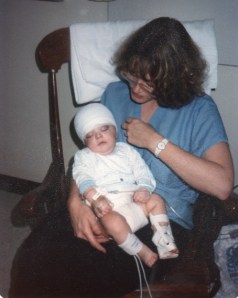 August 2nd…..Today is my son’s 24th birthday. Yeah…I’m old 😉 This is not really the theme of WBW but I will take this opportunity to tell his breastfeeding story on his birthday.