Skip to content

Posts tagged ‘Breastfeeding’

Breastfeeding Barriers

 Barriers~

Even the word itself is foreboding.

Breastfeeding advocacy, lactivism, promotion are important to combat what is really a public health problem and should be a public health priority.     ~Breastfeeding should simply be the norm.


“Today’s medical community recognizes what their

predecessors knew a century ago—that the
American propensity to shun human milk is
a public health problem and should
be exposed as such.
“Today’s medical community recognizes what their predecessors knew a century ago—that the American propensity to shun human milk is a public health problem and should be exposed as such.” 

American Journal of Public Health | December 2003, Vol 93, No. 12

It should be SIMPLE~

It is one thing to talk or write a lot about breastfeeding advocacy and promotion… but WHAT does that really do to break down the hospital barriers. Even with some good ideas or some well-written  plans & protocols(ie. as recommended by The Academy of Breastfeeding Medicine)…. I’m here to tell you, all that does very little to actually change an individual  health-care professional’s actions. There is a critical void in the practice of appropriate breastfeeding management strategies and breastfeeding support from the health-care arena.

Working with barriers day-in and day-out can really open your eyes to what some of us, as lactation professionals or advocates, are dealing with on a daily basis. Many of us are ill-equipped to attempt to enforce evidence-based management guidelines.  There must be better support from the management of each facility, organization or Health-System. It needs to start at the top…. to say we now have an evidence-based breastfeeding policy is NOT enough. I believe it starts with each individual being responsible and accountable for their own practice. 

Action Taken~ 

I have written about how Breastfeeding was taught to me in nursing school and what our scary hospital policy looked like when I got started in this profession. 

I have written an article published in a local parent  magazine to coincide with 2007 World Breastfeeding Week supporting practices to keep breastfeeding SOFT and SIMPLE. 

I have been working on so many different ways to try to keep it SIMPLE… trying to reduce barriers. I have written countless competencies at work while trying to gently re-educate my co-workers. I have developed several PowerPoint presentations, poster in-services, poster displays etc.. to try to help my fellow staff members AND physicians fully UNDERSTAND the superiority & importance of breastfeeding and the use of correct evidence-based management advice, assistance or feeding plans. I have learned to be gentle and patient in the process….one step at a time.

I want to keep it simple for the mother…I’ve tried to work on a simple bottom-line approach to eliminate any maternal barriers of feeling overwhelmed or confused with too much or conflicting information.  

I don’t want mothers to think they have to “study” to pass the breastfeeding test….to “perform” correctly!

I encounter a variety of moms from vastly different backgrounds. There are huge differences in their own individual breastfeeding expectations and goals. We have a large breastfeeding/bottle feeding combination population at my facility. I’ve struggled to balance quality promotion and proper education to both mother’s AND the staff. I continue to to educate with acceptance of all individual mom’s actions. I have written about my approach and maternal guilt.

I wrote:

Never overestimate a mother’s desire to breastfeed her infant.  

Never underestimate a mother’s desire to breastfeed her infant.  

Listen to the mother; help her define her true desires and goals.

Support the mother, support the mother, and support the mother.

This is what I have learned and how some of my approaches and strategies have evolved over the last 20 years so that moms and staff alike will listen. I have written these same things at work…. They are hearing me now. I have to say that at least they are listening and some are talking the talk. How do I get them to walk the walk? Only a select few truly care to try.  The following is some of what we still deal with…

Continued Problems …. Persistent Barriers ~

  • Getting the baby skin to skin in the birthing or delivery room–very inconsistent
  • Accomplishing the first breastfeeding in the delivery area (I even revised the nursing form to REQUIRE documentation of a reason WHY not breastfed….) Most common reasons..attempted, mom tired or mom declined. I have to wonder how often it’s really encouraged…and are they trying to help?
  • Some staff still thinking they have to give that “test” feed of water
  • Keeping a healthy baby in the nursery for hours under “observation” while nurse gets all adm paperwork done
  • Giving handouts to mom but not talking to her, not listening, not helping
  • Telling or directing mom firmly, like it’s an order… often with incorrect info- “you really need to feed that baby, wake him up every 2 hours no matter what”
  • Inconsistent observation of latch and feeding progress (At least some are really good at this!!)
  • Giving partial bits and pieces of correct info mixed with misinformation and not accompanied with actual assistance…… then reporting to me  “I said just what you taught me, Melissa!” (A challange to gently correct)
  • Keeping babies away from mother’s…esp at night so “she can sleep”
  • Incorrect use of  formula— given for so many many reasons that are most often because of all the problems above…… sometimes mom asks for formula…. but a little detective work, proper evaluation, assistance and education can possibly help avoid the formula
  • Not understanding the unique characteristics and needs of the ‘near term’ infant. 
  • Being understaffed when busy… we always have a mom/baby dyad with some need for frequent breastfeeding evaluation and assistance when we are crazy busy….they often get lost in the shuffle
  • Staff members not helping a mom because they tell them to wait for me… I am a staff nurse with multiple duties who happens to be a lactation professional. 
  • The discharge diaper bag from formula companies. ***SIGH***
  • Doctors giving conflicting out-dated feeding management advice
  • Doctors scheduling the first baby F/U visit for 2 weeks on first time breastfeeding moms
  • Persistent Lack Of Management Support and Enforcement of Exsisting Evidence-Based Policies and Protocols which I feel leads to staff apathy

I have been patient, really patient. I have seen progress…real progress. I feel so frustrated to be still dealing with some of these barriers. It is overwhelming and exhausting.  I haven’t been trying to do everything alone. I have “duplicated” myself several times. Some of those individuals are still here, others move on to other jobs, others become apathetic over time. Then we get new people who look at things differently with comments like… “This is what we did at __blank___ hospital..”

What do you suggest could help with the real change……the implementation process??

How do I get them to walk the walk???

Please comment and make a suggestion…  Do you have a good one I haven’t tried?


Breastfeeding, Bottle Feeding and…. Somewhere In-between…. Why the Guilt?

There has been so much discussion circulating in the blogosphere right now about breastfeeding.  I thought I’d add my 2 cents because….I have an opinion and….. I have just a little experience in this field both in study (2 year Lactation course, IBCLC for 10 years, current CLC) and in practice (35 years).

I thought I knew so much in 1988 after nursing 3 babies and assisting others for nearly 15 years. I actually thought I could just take the IBLCE exam based on my experience!

I was so ignorant and naïve!

I started to talk to some IBCLC’s and my eyes were opened wide to the real world. Up to that point, at that time, (I sadly and guiltily admit) I had no idea about the volume of study and research in the field of lactation. I had NO idea just how wrong we were doing things at my hospital.

I launched into a lactation course, soaking up all I could, 3 years of study preparing for certification. I set out to change the world… at least my world. I wrote big proposals for the hospital. I applied for grants to fund a lactation program. I developed education competencies for the staff. I started breastfeeding classes. I thought everybody shared my passion, that they too would want to learn …. because I was right!!

Instead I was the target of all the boob jokes you could think of and I had almost no support. My ideas were rejected left and right.

Long story short…it took me a long time to come to terms with accepting small changes, taking baby steps…..continuing to do the best job I could with each mother-baby couple and to keep a positive outlook. I needed to remain realistic about how much I could actually accomplish one step at a time. Slowly I began to have people under my wing trying to learn. Yeah!

I learned a lot about how to approach physicians, co-workers, managers and most of all …. mothers.

I am not an expert in journalism or critical analysis so this is my opinion of what is going on right now. 

There have been some irresponsible journalists, those who have a bigger platform than most of us, writing negatively about something they have not studied or truly researched. They are expressing their opinion and including an emotional component which has, in my opinion, gotten the reaction they hoped for from breastfeeding advocates as well as those who concur with the authors. More hits, more readers. I feel they have twisted the facts to benefit or support a point they want to make. I read some of them.. other’s I really just scanned then brushed off so I don’t know everything that’s been said. On the positive side, these articles possibly give us a larger platform to provide correct information to a larger public in reply.

I read a lot of blogs and I really respect and admire all the research that many breastfeeding advocates put into their fabulous posts. These are educated women who are trying to provide current accurate information! (@phdinparenting, @bfmom, @MommyNews , @JakeAryehMarcus, @blacktating ,@AmberStrocel,  and so many more). I applaud their passion and breastfeeding advocacy. They are doing a very important job. Breastfeeding IS very important and deserves advocacy, protection and support! There are still large scores of women out there making choices with only tiny bits of information, who really do not know the important benefits of breastfeeding. It is because of this, and because we still haven’t met the US Dept HHS Healthy People Goals for 2010, that breastfeeding advocacy needs to continue. I have been there, advocating in a time where I faced great adversity and a lot of negativity. I am bothered that it still exists…and exists now in so many new ways.

I am more disturbed that some mother’s out there are upset. I always try to understand just WHY a mom feels guilty if she chooses to formula feed or do some combination of formula and breastfeeding. I always hope she’s made her choice with good information and that it is her own true choice. Then good for her! I am not to judge. She needs to be comfortable and confident with her decision. Perhaps her guilt comes from how one single little word or sentence was said, even if what was said is accurate and true. Perhaps her guilt is coming from her own internal struggles. I don’t know.  She needs to come to terms with that herself,  and not punish herself and or publicly criticize the advocates saying they are causing the guilt.  Although there are some very zealous advocates out there, I feel in my heart they are not trying to make any individual mother feel guilty. I read a comment from a mom somewhere that said something like… “perhaps if moms knew it wasn’t all or nothing, maybe more would try breastfeeding.”  My first thought was..why do they even think that..are there really mom’s who feel it has to be all or nothing? Is this causing the guilt because they don’t think they can breastfeed exclusively for the first 6 months as the experts recommend?? 


Over the years, I have learned this:

  • It is inappropriate for a health care professional to indicate to a mother directly or indirectly that formula feeding and breastfeeding are equal. Human breast milk is the superior food for human infants. Properly prepared infant formula is an acceptable substitute for those who cannot or choose not to breastfeed.
  • The first approach is probably the number one factor in gaining a mother’s interest in what you have to say.
  • The education process to a mother needs to be in small doses, sensitive to her unique learning abilities, her cultural beliefs and practices and most importantly, her choices and individual breastfeeding goals.
  • With that in mind, try to provide her with the information she needs to make her decision.
  • Never overestimate a mother’s desire to breastfeed her infant.
  • Never underestimate a mother’s desire to breastfeed her infant.
  • Listen to the mother; help her define her true desires and goals.
  • Many times, the first question she asks may not be what she really wants to ask.
  • The mother’s individual breastfeeding goals, how she defines them, how important they are to her and how she relates them to her actual breastfeeding experience all help define how she measures success.
  • Support the mother, support the mother, and support the mother.


Here are the top 3 responses to the feeding choice question pertaining to breastfeeding at my facility on admission:

  • “Breast and Bottle”
  • “I’m going to do both”
  • “I’m going to ‘try’ to breastfeed”

To each of these I respond very positively with something like… “Great! Tell me what you’ve learned about breastfeeding.”     I will then ask the mom a few questions to somehow find out her true wishes.  

Then I say  “We will support and honor however you wish to feed your baby.  I’d like to give you some information so you can really understand and then tell us what you’d like to do.”  

 I explain some things,  i.e.: how the milk production works, the importance of early feeds etc.. and how formula introduced at that time could  interfere with the process of production, the baby’s ability to latch properly and so on… I usually end with..”We usually recommend to  focus on breastfeeding for now and then offer bottles later after milk supply is established if that is how you’d still like to manage feeding”. ETC…ETC….  Here’s what I then see:

  • There have been so many mom’s who — after a little  bit of information decide they would like to focus on breastfeeding. There have been many who totally fell in love with it.
  • There have also been many who really didn’t want to breastfeed after one single feeding.
  • There are many many still that like to breastfeed and bottle feed in combination right from the start. If they have the right info and understand how things may progress… I still say “Good for you!”
  • I have seen many continue that way for months and they are very happy with that.
  • I’ve seen many mom’s “partially” ( I don’t like to say it that way) breastfeed and feel very proud. I say “good for you!”  They don’t think of it in terms of “exclusive” or “partial”… It’s more like any breast at all…. is breastfeeding vs. no breastfeeding at all.
  • There have been many who also never wanted to try until all of a sudden they see milk leaking!
  • I’ve worked with mom’s where I can see tremendous improvement in her situation, I think she’s going to keep going…but she decides to totally quit. I simply praise her for all her efforts and help her feel proud of herself.
  • I’ve worked with mom’s who have hardly put forth any effort to overcome small obstacles, I think they will probably quit outright… Then..I find out they are the ones exclusively breastfeeding down the road.

I got a comment from a breastfeeding mom @TheFeministBreeder that I absolutely have to share. She describes her own experience in the full comment and on her new blog post.  She comments:

 “Yes, I think that’s the most important part – informing a mother of any and ALL benefits/risks to supplementing, and helping them work through the option they choose.  But to tell a mother to supplement without explaining that it could undermine her efforts is just plain mean.  And too many medpros are doing it.  I’m glad there are more nurses like you who will give out the real information to empower a woman to make her own choice.  My smart friend always says ‘It’s not really a choice if you don’t have all the information.’ “

For those mom’s really trying to breastfeed and struggling, there’s more than I can say right here to cover that. I’m sorry for your struggles and hope it gets easier for you. It is important to have a skilled competent support person assisting you who listens thoughtfully and helps you get to the root of your problem… and helps you define and realize your goals. If you are experiencing guilt from your struggles or from not being able to fulfill your goals, desires to breastfeed….I think that kind of guilt is different from what I’m trying to discuss here. I am not a an expert on that. It is valuable to get the best help out there that you can as soon as possible.

I’m adding this after reading some comments on other blogs.. When approaching a mom to observe or assist with the latch process…. Permission is a must! I ALWAYS ask the mother if she would like any assistance with the latch or if  I may observe how well her baby is latching….. If that answer is yes… The next question is ALWAYS.. May I touch your breast? (if that needs to part of the process). I prefer to help moms by having the mom and BABY do the latch. I try to keep my hands out of it.  All nurses and LC’s should practice this. I am sorry for the mom’s who aren’t asked permission to be helped or touched.  😦


One of my favorite things I like to say to any breastfeeding mom is:

“Try not to make any final decision when it’s dark outside”.


On another note, regarding some reader comments on various blogs about public breastfeeding, a skimpy bikini or the bathing-suit issue of a favorite sports magazine show more skin in a provocative, sexy way than any mom breastfeeding. Even the movie stars in their gowns with plunging necklines are showing almost the entire breast! Somehow, that is OK. There are volumes of video footage and photos all over the place… even on billboards. It is sad that the public opinion of a baby breastfeeding (the most natural way for him to eat) is something that should be done in private … yet young girls are encouraged by media to bare more and more skin. Of course being discreet while feeding is important, but I can assure you, most girls in a tiny bikini are thinking more about “tacky exhibitionist behavior” than a mother breastfeeding her baby. Why aren’t law-makers focusing on any of that?

Scary 1975 Breastfeeding Policy

 This story is about

VINTAGE Breastfeeding information

NOT Current Information


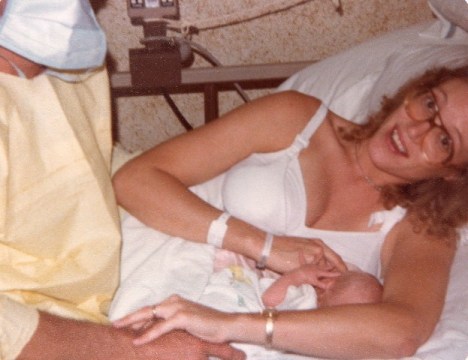
1979 Father wearing gown and mask to attend feeding

1979 Father wearing gown and mask to attend feeding


I have attempted to give an overview of our Maternity Ward as it was when I started to work there. I mentioned how “Once delivered, the baby went to the nursery and became the immediate property of the nurses, only to be seen from a window and allowed to be with the mother at token intervals. The poor little baby was often keep without food/ only water for the first 12 hrs. (Breastfeeding was something only the hippies did.)”

The thought process, as I was instucted even in nursing school, was that most newborns needed to rest after birth, and didn’t require food for 4 to 24 hours. They felt that postponing food would allow time for the mucous to be cleared from the throat and the baby would be allowed ample rest after the exertion of birth and all that handling by doctors and nurses as they provided the necessary care.  My nursing school textbook (Marlow, Pediatric Nursing, 4th ed. 1973) even goes so far as to say that this lag time would allow the mother sufficient rest before giving her infant the breast because….. this first offering is…… difficult. ( Oh… You’d better rest up, dear…)

Another thought process that unfortunately is still around today was that the nurse should not encourage the mother to breastfeed over bottle feed…. least she arouse or cause any maternal guilt feelings. My old textbooks all did list some basic benefits of breastfeeding and proclaimed this as the ideal food. Ie: easier to digest, natural diet for the newborn, convenience, availability AND the provision of identified and unidentified substances which may be protective.  The nurse should provide the information to the mother but not encourage her. They felt prepared formulas (Evaporated or whole milk formulas with added carbohydrates) OR the newer commercially prepared formulas were an “equal” substitute. We did have a full formula preparation room in the nursery with a refridgerator, range, sterilizing equipment etc. When I started, the Similac and Enfamil reps had already just hooked up the hospital with the marvelous free individual bottles of their products which were piled high on top of the former work area for formula prep. I don’t know when they actually stopped making it themselves.

Our 1975 Hospital Policy & Procedure  *

  • We start with NPO (nothing by mouth) for 12 hours.  Then feed one feeding of sterile water to confirm the infants ability to swallow.
  • If the baby has excessive mucus secretions, he should be fed 5% glucose water (G/W)  every 4 hours for the next 12 hrs before his first breast feeding.
  • The father may be present for feedings provided he is properly gowned, wearing hat and mask and has scrubbed hands.
  • For the first breast feeding,  teach the mother to cleanse her nipples with the cotton ball (soaked in a Benzalkonium chloride solotion) and teach proper latch-on techniques where-by the mother should cradle the baby near her breast, stroke his cheek so he turns and assist him to “grip” the nipple when he opens his mouth. Place the baby at both breasts for no longer than 2-3 min each side to avoid sore nipples. Feed the baby 5% G/W if he is still hungry when removed from the nipple.
  • Feedings should be every 4  hours, the mother should cleanse her nipples as above before each feeding.
  • If the baby should cry within 3 hrs of his last feed, he may be offered more 5% G/W.
  • The time spent at breasts should gradually increase to 3-5 min each feed for the first 2 days then continue to increase up to 10 min each side by the 4th day. When her milk begins to flow and the baby will actually be receiving milk.
  • Instruct the mother to pay close attention to which side she began and ended each feeding so she can alternate which side to begin the next feed.
  • Babies will usually require 6 feedings a day for the first several weeks.
  • Once lactation is established, she should be instructed to limit a feeding to 20 – 30 minutes total per feeding. The baby gets 90% of his milk in the first 5 minutes, any additional time is for his enjoyment. Some babies may “cling” to the breast after feeding and may need to be removed. Teach the mother to use her finger gently in the babies mouth to break the suction and remove him.
  • Babies may be taken to the mother for a breast feeding “on-demand” if so written on the chart by the physician


(*This is a combination of information I have from a scanty old policy,
what I remember
and interviewing some older former colleages about what we all actually did.)

If we were unable to get a baby to latch on, we had one tool available to us at the time. We had a hard rubber nipple on a glass base shield that we placed over the breast/nipple and we used the same timing of feeds.  We would only help a mother pump her breasts if she was engorged. The only tool we had to assist her with this was a bicycle horn hand pump. 

There were some pediatricians who were starting to be flexible and improve the approach to breastfeeding in a more natural sense, encouraging initiation earlier and more frequent feeds “on-demand”. There were more professionals opposed to that train of thought and continued their same practices.  When the women started coming in and requesting a better approach to feeding…. they were sabotaged by the nurses who then fed their infants “white water” while in the nursery so these babies would sleep until the next designated feeding time. 

This was 34-35 years ago and I still work with nurses today who have some of these thought processes behind what they do. Many of the older physicians, if taught anything in Med school, were taught similar management protocols. It is such a difficult retraining, re-educating process that some of us face. 

Just last week.. a brand new RN/BSN asked me how the newborn was supposed to survive on colostrum alone?

She was blank faced dead serious. 
I started my answer with…”You are not the first nurse to ask me that very same question and it’s a good question. Here’s why etc……..”
I hope I answered her well enough so she can someday teach the next one and the next…..
We really need much better Lactation Education 
for our Doctors and Nurses.
They should not be so uneducated or ill-equiped 
to properly care for and advise the mother’s in their care!