Skip to content

Posts tagged ‘Cesarean’

Not your Usual Birth Plan

002


A birth plan is usually a written plan from the mother to her caregivers describing her wishes, what type of options she’d like to take advantage of, things she would like to happen thru out her labor and birth, what things are important to her as she experiences birth.  There are various resources out there to help a new mom explore options and formulate a plan.. especially for a hospital birth.  It is important that the mom review this with ALL her care providers AND especially the L&D nurses…. the advocates who help you actually realize the goals with in your plan. I have a fellow L&D nurse blogger who has done extensive research on the topic and wrote a 2 part series on Writing Your Birth Plan- Tips from an L&D Nurse over at nursingbirth. I would highly recommend you check it out especially if you plan on a hospital birth.

Many times these birth plans accompany a mom’s prenatal chart weeks in advance of her birth. Over the years there has been a gradual acceptance of the plans in my facility where historically, there had been much resistance for the mother’s input what so ever.  Much like the attitudes towards homebirth…. The doctors or nurses would casually peruse the plan then toss it aside and have a good laugh…. saying…. ” oh- she’ll end up a section for sure!”  Unfortunately, they were often right about that– many of those early birthplans never seemed to go as mom wanted, giving the staff fodder for snide comments and remarks. Sad but true. 😦

Recently, we recieved a birth plan that was not at all like any other.  Maybe some of you have seen plans like this… maybe some of you actually wished for births like this…. Hey~ who am I to judge? …. I am only here to help,  it isn’t my birth.

Her Birth Plan requested:

  • Pain medication as soon as possible….. I prefer to have an epidural as soon as possible
  • Please do not try to make me have breathing patterns through contractions… I’m afraid I’ll be too nervous
  • If a Cesearean is needed, please put me to sleep
  • I want only my mother with me in the labor and delivery of my baby
  • When the baby is born, I do NOT want to touch him until you clean him off
  • You can do his eye ointment and Vitamin shot, bath and all procedures before I hold him
  • I want to hold him wrapped in a blanket, not skin to skin
  • I want the baby to be in the nursery as much as possible at night so I can rest
  • I want to feed my baby formula from a bottle. I don’t want to breast-feed
  • I want to stay in the hospital for the whole allotted time so I can rest

My first thoughts were… Sweetheart, you could have ALL THIS without even asking!” ……..

Sadly, despite all efforts to improve,  …  things still happen exactly like this for many births.  We just don’t usually see it written out as a formal request or plan!  At least this is how this mother wanted things to happen.

This little mommy came in and delivered vaginally. Her plan was very easily carried out. 😉  I am very happy to report that she and her son were healthy and she displayed very postive interaction with him. Very loving and caring. She was very very happy with her birth and with being a mother!

That is all that really matters in the end.  Options– and what you as an individual would like to have for your birth. How much education she had before chosing these options… I’ll never know.

 Now I am asking the rest of cyberspace world.. have you ever seen birth plans like this???

A Formula Rep turned my Maternity Leave Injury into a new career as an IBCLC? Really?

matleavecarnivalbox

My contribution to this fabulous Carnival of Maternity Leave  , is a story of how during my maternity leave, an injury occurred leading to a career change specializing in Lactation… ! It starts with the birth of my third and last baby…… A  girl….. (after 2 boys) was also born by C-Section.. a first for me.

Well– first, let  me back up a few years… I’ve had a potpourri of maternity leaves. I have been a Maternity/L&D/Nursery since the mid 70’s.  I always worked full time and had never entertained thoughts of staying home with my children once they were born because the USA didn’t assist in providing any type of viable option for families who rely on two incomes or single moms with one income.  Prior to FMLA,  maternity leave was pretty much up to the employer as far as I understand it. The USA doesn’t offer any paid leave (unless offered by individual employer). For my first baby in 1979- I took 7 .5 weeks and went to a weekend 12 hr shift job which at least allowed me 5 days each week with him. 

 When my next baby was born in 1985, I worked at the same facility I am now. We were allowed to save up ALL Vacation, Holiday, and Sick time to be used collectively with your hospital allowed 12 weeks off.  I was able to have 5 1/2 months total, partially paid time to be with my new baby. Since he had to have surgery at 3 months, I needed that time and could have used more.. My leave was actually supposed to end on Christmas day (YUK).. however, they graciously allowed me to come back on the 26th… also his first day in Day Care. 😦

So back to my third baby in 1988~I had had a C/S — (that’s another story).  I had to be hospitalized for 10 days after the surgery with a whopping infection. A fresh incision and chills with a temp of 103.8 do not go well together! [Nurse Curse] Anyway, I made it thru–> healed and returned to life as a mother of three. The same type of collective accumulated paid hours were allowed withthe hospital’s offered 12 weeks. I didn’t have as many hours saved up as last time but was hoping for the best length of time.  One day in church, I held my little 2 month old baby girl on my shoulder with one hand, while using the other to hold the hand of my active 3 yr old boy as we made our way down the aisle. Suddenly, my boy squealed with delight and whipped over in a different direction. I held my daughter and did a sudden twist and reach for my son as he squirmed away. I immediately felt something “give” in my back.

It took a few days for me to feel the true extent of the injury. I thought it was just a little pulled muscle. After a 5 hour drive to my sister’s for a family visit, I ended up writhing on the floor with the unstoppable intractable “fire hot poker” pain of full blown sciatica…. all down my right side. I had to go to the hospital ER away from home, unfamiliar doctors, for help and drugs! Boy, I needed relief. As explained to me by the doctors… this was not the same as sciatica from many other causes. This was a swollen inflamed sciatic nerve… we didn’t know why yet.  The only thing helping at that point was medication and ice.. a lot of ice. I still insisted they give me meds I could take while breastfeeding, so they weren’t too strong.

I got home, went thru an MRI and diagnostic process, different doc’s, different opinions. I had a disc “blow-out” with”free extruded disc fragments” at L5-S1. Some felt surgery was needed immediately, others said to wait.  After careful consideration, we decided to wait and do some conservative type treatments with oral and epidural steroids. I still had to heal well enough to work, though. I spent many nights crying and wondering HOW I could work ??? How could I go and be on duty…running all over to keep up with the pace, helping people thrulabor and delivery…respond to emergencies…how?? I could barely care for my family! I called many friends while I was on periods of bed-rest and had various treatments during the time I had left of maternity leave. (I eventually did have to extend the leave a couple weeks for more recovery. I ended up witha 5 month leave altogether). I was searching for ideas.. visions of something less physically taxing which could combine my knowledge of labor/delivery/postpartum and neonatal care….. and allow me to continue working. I was, after all, the major bread-winner in our family!

Finally, a friend came up with an idea. He was actually a formula and drug rep for Ross labs.. TRUE!! But he was a friend, had heard I was hurt and stopped by the house to see how I was. He was a rep to many hospitals in the NorthEast and had exposure to what else was going on– what other hospitals were doing.  This was 1988, only a few years after the emergence of the Lactation Consultant profession. I had never heard of it. Sometimes word traveled slowly (by pony express) and things changed slowly in my little neck of the woods. He encouraged me to check it out and gave me phone numbers of LC’s at some of his other hospitals. I was really excited! I called a few and found out more about the lactation profession and the relatively new Board exam given every year in July to gain the credential of IBCLC.  I was actually naiveenough to think I could take the exam with my current knowledge base!  HA! (Unfortunately, this is what many nurses with a little experience think…we think we already know it all! Ha!) 

I called one of the LC’s at a hospital not too far from me. We talked a while and I had my eyes opened as to the extensive and vast knowledge base needed to become a lactation professional. I launched a quest for the best way to gain this knowledge. I joined LLL and went to meetings. I made home visits with the local LLL leader. I wrote many letters, made many phone calls searching for some type of education program. (remember– no Internet back then!)

Finally I found the perfect program for me. There was a correspondence course offered to be done all through the mail and phone calls designed to be an 18 month course.  It was a Lactation Consultant Course offered by BSC Breastfeeding Support Consultants! (the link shown is for their current course) Back then, you could be called a Certified Lactation Consultant after completing the clinical practicum and final exam. Because of continued back problems, I started this course in early 1989, had to take a few months leave from the course and completed it in early 1991. I then went on to continue studying and sat for the IBLCE exam in 1993 earning  my IBCLC status!

I have always continued to work as a staff nurse. I found a corset style back brace and found the best balance possible between family, back pain, work and more pain. I was able to get the pain subdued with steroids to carry on with life. In 1992, during a particularly gruesome relapse, I eventually consented to a myleogram… something I had previously NOT wanted. They also did a CT scan while the dye was in place. These tests showed my right Sciatic nerve had been pushed way up out of place by the disc material. I consented to surgery by a fabulous neurosurgeon the very next day. It turns out, the disc was actually adhered to my sciatic nerve!! He had to meticulously excise it off the nerve!!  My post-op pain was minimal compared to the pain I had before surgery. I was able to go back to full duty in 8 weeks!

Over 20 years later, I am still working as a staff nurse and am now a CLC… Certified Lactation Counselor.  Becoming a breastfeeding professional has enhanced and fortified my life! I am immensely happy I have gone down this road. To think it all came about as a suggestion from a Formula Rep!?!?!

Hope all had a great WBW 2009!!

Hope all had a great WBW 2009!!

HomeBirth Transfer~ Doc says NO to C/S~

I wrote a few stories a few weeks ago because I was proud of my hospital that week– sorry I didn’t finish the stories until now……

iStock_000004564778Small

~She lived about 8 -10 miles outside of town. “Ellie” was having her first baby at age 32.  First baby, first pregnancy, no risk factors…. an easy uncomplicated pregnancy. She had done some research, not extensively, judging from some of my conversations with her and her husband…but she knew what she wanted. She had made a beautiful plan with a CPM for a water tub home birth. This particular midwife has been doing home-births in my area for a long time.. (She was the one cowering in the L&D hallway in this story…). The story of how things progressed up to transfer to the hospital was told to us by both the mother, father and midwife. 

~Her labor started with regular contractions at 39 weeks. They progressed from early labor which lasted around 6 hours to a more active labor with contractions about every 2- 3 minutes.  Her cervix had dilated to 6-7 cm. This pattern of contractions continued for hours. Ellie was in and out of the tub, walking, dozing, in and out of the shower, squatting, doing many different position changes throughout the next 6 to 8 hours. When she was re-examined by her midwife, she had made no cervical change in all that time. This can happen sometimes, things can stall out and pick back up again. Ellie reported that the contractions may not have been as strong at that, so she wanted to wait it out, maybe nap. The baby’s heart rate checks were all good.

~Everyone rested about 2 hours … Ellie’s water broke (clear fluid)  about 1 am and her contractions got more intense. The CPM checked her cervix about 3 am and felt no change. She still was 6 -7 cm dilated and the head was at about -2 station. The midwife then brought up the idea of possibly transferring to the hospital. Ellie said NO! Is my baby alright? “Yes….” said her midwife.. “Then No..I’m staying here, — I can do this.”

~Back to the tub… In and out of the shower, total body massages.. contraction pattern the same with increased intensity…next cervix check at 730 am… still 6-7 cm. Now Ellie was tired. Really tired. Exhausted! The baby was great on all checks. Her midwife again brought up the transfer to hospital idea, talked to her about the possibilities of pitocin, epidural etc… Ellie was now wanting anything, agreeing with anything–to get this over with.

~She arrived at the hospital around 8- 830 am very upset. Her husband and midwife were with her and her CPM had all her prenatal care info. Some of the first words out of Ellie’s mouth were that she wanted an epidural and a Cesarean! The nurses on duty this morning were awesome! They calmed her down, had her hooked up to the fetal monitor and observed her contraction pattern and the fetal heart rate pattern response. The baby looked excellent! The midwife and hubby coached her through the contractions while the nurses gathered their admission data.  The doctor checked her and she was still about 6-7,  swelling of the cervix noted, about -1 station. Ellie asked him if he would please do a C/S and he said no… (yeah!).  He said that he felt the best option at this time was to do the epidural she was asking for and observe her contraction pattern… possibly add Pitocin. He talked to her so nicely and non-judgmentally. Many of the other docs would have taken her right into the OR with very little discussion of options. She had been 6-7 cm dilated for some approximate 16 hours.

~After the epidural, Ellie and her husband and midwife all slept. The doc did NOT start pitocin right away, he said that she may need to rest and the contraction pattern couldstart to become of better quality once she rested and was better relaxed. WOW! Where did this guy come from? I’m so amazed and happy and quite frankly, shocked. This was a newer OB here.. I wanted to ask him where he’d been all my life! I went in to talk to Ellie and introduced myself. I told her I was so sorry thingsweren’t progressing the way she had hoped and sorry she didn’t get to stay home. She thanked me and said at this point, she was ready for it to be over! I told her she was really quite fortunate to have this particular doctor on duty today. Except for one bad apple from the night shift just leaving when Ellie arrived, everyone was wonderfully supportive and accommodating. Ellie’s contractions indeed did start up in a better intensity pattern on their own….. however their continued to be a lack of progress.  Once again, she asked the doctor to get it over with now and please do a C/S. 

~The doctor said NO again! He explained that her uterus was probably tired and the quality/intensity of contractions just may not be what was needed for the job to get done. He explained that the fetal heart rate tracing was beautiful and her membranes had been ruptured less than 12 hours. No baby risks…  He felt it possible the baby merely needed to get in better position and the contraction quality needed to improve.. and then he would re-evaluate. Ellie agreed with renewed optimism. The pitocin drip was started. She didn’t need much before the contraction pattern got much stronger, longer and better quality.  He came to re-evaluate her only after these better contractions had been consistent for 2 hours. The vaginal exam revealed the cervix was the same ..still the same and possibly more swollen.  He said he felt the head was not as well applied to the cervix as it had been.. but still at -1 station. He examined her with and without a contraction. Same in his opinion. Ellie lost all her fight. Her support people rallied to help her, but she was now insistent.

~This time the doctor  said she certainly had reason to feel this way, had given this a great try. He told her he still felt she could try longer… that we could alter positions with the pitocin, keep her comfortable with the epidural and keep going… the baby was handling all this just fine. He did say that there was a possibility the baby had his head in a tilted position making it difficult to descend the birth canal. He then let it up to her and told her if she wanted the C/S, he would do it at this point.

~YES I want a C/S! Ellie exclaimed. We did the C/S about 3 pm… some 7 hours after transfer and approximatelyclose to 24 hours of being 6-7cm dilated. Her gorgeous 7 lb baby boy was delivered operatively with apgar scores of 9 and 9. Pink and vigorous! Beautiful. I was able to get him skin to skin in the OR.. that was one of the first times all the players didn’t object and I went with it! (It won’t be the last….and next I’m trying for breastfeeding on the OR table!) Upon delivery, the OB noted the baby had been acynclitic . This is when the head is tilted to the side, ear towards the shoulder.  It is probably responsible for her long stall in labor. The OB still felt she could have delivered vaginally given time and good management. I am just so happy he was there.  I am proud of this mom, her partner and midwife and of our whole team! This mom was able to make good educated choices about her care despite dealing with the stress of a transfer.. and was able to feel so very very proud of how hard she tried.

In the end it was her…… who gave in to the C/S … not her doctor. 

Of that we can be proud

🙂

Cesarean Delivery of the Second Twin… Why? 

029I was talking to one of my on-line Twitter friends @onefinebreeder about twin delivery. I was telling her about how things used to be.. how vertex-nonvertex twin gestation’s were always delivered vaginally ….. and she commented on how it was sad that some of the old OB skills have been totally lost to surgery… So Very True!

I got to thinking about the first combination Twin delivery I had witnessed back in the very early 80’s. This was actually one of our own (hospital employee) nurses .  She was a multip…. around 37-38 weeks and healthy…no complications during pregnancy. Twin A delivered spontaneously, vaginally with a generous episiotomy as they often performed at that time… The baby , a girl, was about 6 pounds, vigorous and had no problems. We were all marveling at the first baby, checked fetal hearts on the second twin and started waiting for him to get in position.  Still before consistent ultrasound, we were not worried. However, we had a newer doctor who was attending this birth. He began to get concerned after 5- 10 min when contractions slowed and he was worried that if this baby was breech, he would have difficulty with the “after-coming” head. Up to this point, all I had learned was this can be a real concern if the smaller feet or buttocks present through a cervix which is not fully dilated. Much research was done later on but at the time, I did not know about it. He began to ask us to call the OR for a C/S. This was unheard of in my limited experience at the time…. my 70’s world. I thought.. how can they do a C/S now when one baby was already born??? I tried to be an advocate… (my early days… )”We have Piper forceps…”  I said meekly… “Have you tried to grab a large part and help bring the baby down… ?” This was my limited knowledge… all I knew to suggest. I kept wishing one of the other doctors was on duty that day.. or maybe we could call them???

In front of the mother, he said to me “I’m not going to have a bad outcome here!” By now it was 20 minutes or so. There was no cord prolapse, no drop in fetal hearts, no evidence of immediate trouble… the baby was seeming to work itself into breech position…. To the mother he said “Your baby is in serious danger and the best thing to save him is to take you for a Cesarean now!” “I’ll sew your episiotomy together while we are in the OR.”

I was in shock. She signed, scared to death of course. So we prepped her for the OR. She went up for a C/S of her second twin and repair of her generous episiotomy. Her second baby was delivered frank breech…  a beautiful boy about the same size and was also vigorous and healthy. I remember I felt as though she was almost assaulted. I remember feeling that this was a true rare event if it every happened before. There was no immediate access to information like today.

Luckily mom and babies did fairly well in the postpartum period even though healing from both the episiotomy and the C/S was difficult for her.
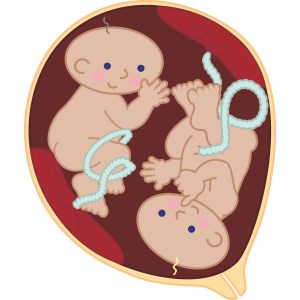
"How can I get out if I'm not head 1st ??"

" Psst-- How can I get out if I'm not head 1st ??"

I wanted to see how much research I could find on this topic. I had gone to the green journal (OB & GYN) website but then it locked me out. (You can only look at abstracts anyway unless you want to purchase the article. You are on your own for that.) I had some luck with the abstracts at PubMed so I have put a few here.

I decided to take a look across time…….

This first one is from 1981. . Quoted abstract from the PubMed site:

Cesarean Section for Delivery of the Second Twin

Evrard,JohnR.; Gold, Edwin M.
Obstetrics & Gynecology. 57(5):581-583, May 1981.

Four cases of combined vaginal-abdominal delivery of twins are presented, and an additional 5 cases from the recent literature are discussed. Malposition, malpresentation, and contracted cervix were the main indications for cesarean section for the birth of twin B. In the 9 cases presented, there were 2 perinatal deaths.

Interesting that this research was done during the same time frame as my experience above. I’d like to know more about those poor outcomes 😦

The next interesting article I found was researched over a 10 yr period, somewhat close to here in a larger facility, published 1997. THIS study examines the delivery of the second twin by utilizing external version vs breech extraction . 😉 The results are showing in favor of breech delivery vs version (those meeting exclusionary criteria ).. Versions were associated with higher a incidence of Cesarean and fetal distress. Neonatal outcomes no different and are stated below:

Method of delivery of the nonvertex second twin: a community hospital experience.

 Smith SJ, Zebrowitz J, Latta RA.   J Matern Fetal Med. 1997 May-Jun;6(3):146-50

Abington Memorial Hospital, Pennsylvania, USA.

The purpose of this study is to examine the incidence of cesarean section and fetal distress complicating the delivery of the second twin in vertex-nonvertex twin gestations in which the second twin underwent either breech extraction or external version. The intrapartum courses of 510 twin gestations delivered at a community hospital over a 10-year period were retrospectively analyzed. All vertex-nonvertex twin gestations were identified in which the second twin underwent attempted breech extraction or external version. Exclusion criteria included birthweight < or = 1,500 g, fetal anomaly, intrauterine demise, and monoamniotic twins. Of the 76 twin sets that met inclusion criteria, 33 underwent external version and 43 underwent primary breech extraction. The two groups had similar demographic characteristics. External version compared to breech extraction was associated with a significantly greater incidence of cesarean section (8/33 vs. 1/43, P = .008) and fetal distress (8/33 vs. 1/43, P = .008). There was no difference between groups in neonatal outcome for the second twin as measured by length of stay, 5-minute Apgar < 7, intensive care unit admissions, hyaline membrane disease, intraventricular hemorrhage, and traumatic birth injury. In conclusion, the increased incidence of cesarean section and fetal distress in patients undergoing attempted external version suggests that breech extraction may be the preferable route of delivery for the nonvertex second twin weighing more than 1,500 g

The next study was published a little later in 2001 and covered a 20 year span of time… during the 80’s and 90’s at a larger center in Nova Scotia, Canada. They noted an increase in their combination vaginal/cesarean twin births and documented some statistical data, looked at reasons for an operative second twin birth. I wish to read this study further some day to see if there is mention pertaining to mother/baby outcomes other than statistics outlined (even though that wasn’t their objective) in this abstract:

Combined Vaginal-Cesarean Delivery of Twin Pregnancies

Obstetrics & Gynecology . 98(6):1032-1037, December 2001.

Department of Obstetrics and Gynaecology, Dalhousie University, Halifax, Nova Scotia, Canada.

OBJECTIVE: To estimate the incidence and factors associated with combined vaginal-cesarean delivery in twin pregnancies. METHODS: We studied all twin births weighing 500 g or more during a 20-year period (1980-1999) at a tertiary care center. Major anomalies, monoamniotic and conjoined twins, and antepartum fetal deaths were excluded.

RESULTS: During this 20-year period, 105,987 women delivered, of whom 1565 (1.5%) had twins. Of these, 1151 twin sets fulfilled the study criteria. The mode of delivery was vaginal in 653 (56.8%), cesarean in 448 (38.9%), and vaginal-cesarean in 50 (4.3%). During the 20 years there was a statistically significant increase in combined vaginal-cesarean and elective cesarean deliveries, with a decrease in vaginal deliveries. Parity, gestational age, and birth weight discordance (>25%) were not associated with combined delivery. Compared with vaginal delivery, the nonvertex second twin was associated with a twofold higher risk of cesarean delivery (relative risk [RR] 2.3; 95% confidence interval [CI] 1.3, 3.8; P =.002); and an interdelivery interval of over 60 minutes with an eightfold higher risk (RR 8.2; CI 4.6,14.6; P <.001). Vaginal-cesarean delivery had a 22-fold higher use of general anesthesia compared with vaginal delivery (RR 21.8; CI 5.4, 88.5; P <.001). CONCLUSION: There has been a significant increase in combined vaginal-cesarean and elective cesarean deliveries among twin gestations, with a decrease in vaginal births. Vaginal-cesarean delivery is associated with nonvertex second twin and a prolonged interdelivery interval.

Now we come to 2008!  There is a study here from Texas. This study looked a twins born by C/S after labor and twins who had cesarean birth of the second twin. they campared outcomes to see if the twin of a combined delivery had more problems. The most important pieces of information I gather from this abstract of results…. (again, having NOT read the entire study):

“Combined twin delivery may be associated with endometritis and neonatal sepsis when compared with a twin delivery where both are delivered by cesarean in twin pregnancies experiencing labor. More serious neonatal sequelae, including hypoxic ischemic encephalopathy and death, were not affected by the route of delivery of the second twin.”  Hmmm 

Cesarean Delivery for the Second Twin

Alexander, James M.; Leveno, Kenneth J.; ….et al:for the Eunice Kennedy Shriver National Institute of Child Health and Human Development (NICHD) Maternal-Fetal Medicine Units Network (MFMU)   Obstetrics & Gynecology . 112(4):748-752, October 2008.

Department of Obstetrics and Gynecology, University of Texas Southwestern Medical Center at Dallas, 5323 Harry Hines Boulevard, Dallas, TX 75235-9032, USA. james.alexander@utsouthwestern.edu

OBJECTIVE: To examine maternal and infant outcomes after a vaginal delivery of twin A and a cesarean delivery of twin B, and to identify whether the second twin experienced increased short-term morbidity as part of a combined route of delivery. METHODS: Between January 1, 1999, and December 31, 2000, a prospective cohort study of all cesarean deliveries was conducted at 13 university centers. This secondary analysis was limited to women with twin gestations who experienced labor and underwent cesarean delivery. We compared outcomes of the second twin in women who had vaginal delivery of the first twin and a cesarean delivery of the second twin to those who had cesarean delivery of both twins. RESULTS: One thousand twenty-eight twin pregnancies experienced labor and underwent cesarean delivery; 179 (17%) had a combined vaginal/cesarean delivery. Gestational age at delivery was 34.6 weeks in both groups (P=.97). The rupture of membranes to delivery interval was longer in the combined group (3.2 compared with 2.3 hours, P<.001). Endometritis and culture-proven sepsis in the second twin were more common in the combined group, respectively (n=24, odds ratio 1.6, 95% confidence interval, 1.0-2.7; n=15, odds ratio 1.8, 95% confidence interval, 1.0-3.4). These differences were not significant after logistic regression analysis. There were no statistically significant differences in an arterial cord pH of less than 7.0, Apgar score less than or equal to 3 at 5 minutes, seizures, grade III or IV intraventricular hemorrhage, hypoxic ischemic encephalopathy, or neonatal death. CONCLUSION: Combined twin delivery may be associated with endometritis and neonatal sepsis when compared with a twin delivery where both are delivered by cesarean in twin pregnancies experiencing labor. More serious neonatal sequelae, including hypoxic ischemic encephalopathy and death, were not affected by the route of delivery of the second twin.

I gather from these studies that a combined delivery route leads to more problems.. however…there are probably more problems than breech presentation alone to lead the provider to make that choice. I believe that many newer providers of obstetrics in a hospital setting are more apt to do a scheduled C/S for any vertex-nonvertex twins they encounter. That is what is done in my facility today. The same for all breech presentation singleton gestation.

Where is that old-fashioned nurse when you need her?? How ’bout the old fashoined doc??? 😉

I am very interested in anyone’s story or experience either in healthcare or your personal birth. Please let me know if you know anything about this!

Thanks for reading!

Wordless Wednesday…..

When Blood and Birth were considered CLEAN

When Blood and Birth were considered CLEAN

Thought I’d try this Wordless Wednesday style post. I give you a question….

Do any of you remember when Blood and Birth were considered CLEAN?

No gloves needed or used unless you would be STERILE or handling contaminated items??

Anyone??


No gloves

No gloves

Scary 1975 Breastfeeding Policy

 This story is about

VINTAGE Breastfeeding information

NOT Current Information


1979 Father wearing gown and mask to attend feeding

1979 Father wearing gown and mask to attend feeding


I have attempted to give an overview of our Maternity Ward as it was when I started to work there. I mentioned how “Once delivered, the baby went to the nursery and became the immediate property of the nurses, only to be seen from a window and allowed to be with the mother at token intervals. The poor little baby was often keep without food/ only water for the first 12 hrs. (Breastfeeding was something only the hippies did.)”

The thought process, as I was instucted even in nursing school, was that most newborns needed to rest after birth, and didn’t require food for 4 to 24 hours. They felt that postponing food would allow time for the mucous to be cleared from the throat and the baby would be allowed ample rest after the exertion of birth and all that handling by doctors and nurses as they provided the necessary care.  My nursing school textbook (Marlow, Pediatric Nursing, 4th ed. 1973) even goes so far as to say that this lag time would allow the mother sufficient rest before giving her infant the breast because….. this first offering is…… difficult. ( Oh… You’d better rest up, dear…)

Another thought process that unfortunately is still around today was that the nurse should not encourage the mother to breastfeed over bottle feed…. least she arouse or cause any maternal guilt feelings. My old textbooks all did list some basic benefits of breastfeeding and proclaimed this as the ideal food. Ie: easier to digest, natural diet for the newborn, convenience, availability AND the provision of identified and unidentified substances which may be protective.  The nurse should provide the information to the mother but not encourage her. They felt prepared formulas (Evaporated or whole milk formulas with added carbohydrates) OR the newer commercially prepared formulas were an “equal” substitute. We did have a full formula preparation room in the nursery with a refridgerator, range, sterilizing equipment etc. When I started, the Similac and Enfamil reps had already just hooked up the hospital with the marvelous free individual bottles of their products which were piled high on top of the former work area for formula prep. I don’t know when they actually stopped making it themselves.

Our 1975 Hospital Policy & Procedure  *

  • We start with NPO (nothing by mouth) for 12 hours.  Then feed one feeding of sterile water to confirm the infants ability to swallow.
  • If the baby has excessive mucus secretions, he should be fed 5% glucose water (G/W)  every 4 hours for the next 12 hrs before his first breast feeding.
  • The father may be present for feedings provided he is properly gowned, wearing hat and mask and has scrubbed hands.
  • For the first breast feeding,  teach the mother to cleanse her nipples with the cotton ball (soaked in a Benzalkonium chloride solotion) and teach proper latch-on techniques where-by the mother should cradle the baby near her breast, stroke his cheek so he turns and assist him to “grip” the nipple when he opens his mouth. Place the baby at both breasts for no longer than 2-3 min each side to avoid sore nipples. Feed the baby 5% G/W if he is still hungry when removed from the nipple.
  • Feedings should be every 4  hours, the mother should cleanse her nipples as above before each feeding.
  • If the baby should cry within 3 hrs of his last feed, he may be offered more 5% G/W.
  • The time spent at breasts should gradually increase to 3-5 min each feed for the first 2 days then continue to increase up to 10 min each side by the 4th day. When her milk begins to flow and the baby will actually be receiving milk.
  • Instruct the mother to pay close attention to which side she began and ended each feeding so she can alternate which side to begin the next feed.
  • Babies will usually require 6 feedings a day for the first several weeks.
  • Once lactation is established, she should be instructed to limit a feeding to 20 – 30 minutes total per feeding. The baby gets 90% of his milk in the first 5 minutes, any additional time is for his enjoyment. Some babies may “cling” to the breast after feeding and may need to be removed. Teach the mother to use her finger gently in the babies mouth to break the suction and remove him.
  • Babies may be taken to the mother for a breast feeding “on-demand” if so written on the chart by the physician


(*This is a combination of information I have from a scanty old policy,
what I remember
and interviewing some older former colleages about what we all actually did.)

If we were unable to get a baby to latch on, we had one tool available to us at the time. We had a hard rubber nipple on a glass base shield that we placed over the breast/nipple and we used the same timing of feeds.  We would only help a mother pump her breasts if she was engorged. The only tool we had to assist her with this was a bicycle horn hand pump. 

There were some pediatricians who were starting to be flexible and improve the approach to breastfeeding in a more natural sense, encouraging initiation earlier and more frequent feeds “on-demand”. There were more professionals opposed to that train of thought and continued their same practices.  When the women started coming in and requesting a better approach to feeding…. they were sabotaged by the nurses who then fed their infants “white water” while in the nursery so these babies would sleep until the next designated feeding time. 

This was 34-35 years ago and I still work with nurses today who have some of these thought processes behind what they do. Many of the older physicians, if taught anything in Med school, were taught similar management protocols. It is such a difficult retraining, re-educating process that some of us face. 

Just last week.. a brand new RN/BSN asked me how the newborn was supposed to survive on colostrum alone?

She was blank faced dead serious. 
I started my answer with…”You are not the first nurse to ask me that very same question and it’s a good question. Here’s why etc……..”
I hope I answered her well enough so she can someday teach the next one and the next…..
We really need much better Lactation Education 
for our Doctors and Nurses.
They should not be so uneducated or ill-equiped 
to properly care for and advise the mother’s in their care!

Our HOSPITAL’S First Planned VBAC

I say our hospital’s first planned VBAC (Vaginal Birth After Cesarean)….. however a prelude is necessary because the actual first VBAC I can remember…. totally freaked everyone out. Here are the stories:

Sometime in the mid 70’s -circa 1976, a mom came in to L/D for a labor check. She was near term with some regular contractions, a little bit of bloody show. The nurse calmly wrote her name down in the notebook…. [Yes– a notebook, that’s the only way we kept track of labor checks back in those days. No medical record, no registration, just a name in a book and the day they were here and checked]… She was getting ready to gather more information when the mom said she had a history of a prior C/S.
Suddenly all the nurses were scrambling—“Quick, call the doctor!” “Quick, shave her belly,” “Get the Fetal Hearts” “Call the OR and tell them we have a STAT C/S”…We were all busy quickly getting her ready for the OR.
This little baby, however, definitely had other ideas. The mom told them she had to go to the bathroom…
Someone said: “Not now honey, we’re going to get you to the operating room to have your baby.”
The Mom: “But—I have to go….. AUGHHHH” (loudly grunting)
One of the seasoned nurses threw the sheets back and low and behold, that little baby was crowning!! “Doctor W– No time for the OR– This baby is coming!”
She did deliver vaginally, quickly, and everyone was in a state of shock!
I was thinking– I didn’t think that was possible–they told me once a cesarean always a cesarean—they told me the uterus would rupture–that the mother would hemorrhage. She and her baby were just fine. I realized once again that I had a lot to learn!

Fast forward now to 1984.

I was sent a nicely written post on the VBAC Pendulum by Dr Shelley Binkley which discusses the rise and fall of VBAC’s in the US and makes for very interesting reading. There’s been tremendous controversy surrounding this topic.

VBAC’s were widely discussed in the literature at early to mid 80’s and many women were interested…the doctors???– not quite so sold on the idea.  However, in the late 70’s early 80’s, we had one very progressive young doctor (Dr.B)  in the main OB practice.  He was responsible for many of the advances we had in a more natural approach to childbirth.  He was willing and eager to give this a try. 

I am not sure what he may have discussed in the office with his patients or how he may have selected his first patient who could try for a VBAC.  Knowing him, he may have brought it up to mom’s instead of the mom bringing it up to him. Anyway– sometime in the summer of 1984 we heard we would be having our first VBAC! She was due in December with her second child. Her first baby had been delivered at our hospital by Dr. B via C/S because of some fetal distress.  He knew her history and had full access to her records to know exactly what type or uterine incision she had.  She was young, healthy and continued her pregnancy to term without any complications. She was very excited. 

The hospital staff was a nervous wreck.

Where oh where were we going to labor her so that should ANY complication arise, we could do the fastest C/S possible??? We didn’t do C/S’s on our unit. The OR was down a floor and in another wing!!! Such a dilemma.  They finally decided to use the tiny windowless isolation room of the Recovery Room right outside the OR.  They decided to bring all the equipment from L/D down to that room to see how it all fit. We had a regular bed,overbed table, the fetal monitor, some other IV equipment/meds/ supplies etc.. a chair for dad, stool and sm desk for nurse…all crammed in the room. (OK- we scrapped the desk..that was rediculous) We were literally practicing like when they do separation surgery for conjoined twins!!  Quite the production. 

Ready or not, here she comes…….arriving in labor almost a week late at 40 5/7 weeks.  She was in very early labor much to the relief of everyone involved. OF COURSE I was on duty! OF COURSE I was elected to be her nurse! I was after all, the most prepared (say all my co-workers).  So while other’s got the room ready downstairs, I admitted her. There were no special consents at the time.  My orders were continuous fetal monitoring,  start an IV right away, AND insert a Foley catheter so we would keep the bladder drained, avoid any excess pressure on the uterine scar and keep her from needing to get up.  I also had to do a big shave prep in case of an emergent C/S. We took her down to that tiny closet of a room when it was ready, around noon. She was still in early labor.  The plan was to do a double set-up in the OR for delivery. That meant a whole set-up for a vaginal birth and a whole set-up open for a C/S complete with the entire OR team. They would call them in when she was in active labor. She had progressed to 7 or 8 cm with her first baby before needing a section so the thought was she’d go fast this time. 

Early labor continued into the late afternoon. All the managers involved kept stopping in repeatedly with all the same questions:….. “Is everything alright??”….. “Any problems??” …..”Any sharp pain in the lower abdomen?”….. “Any blood in the urine?”…….. “How about any excess vaginal bleeding?” ……..They were making me crazy.  We didn’t do any Pitocin augmentation. This poor mom was just in bed the whole time, in the closet with the single bright light, moving around when I suggested changing positions. Finally she headed into active labor and then did progress quickly to transition.  The membranes ruptured spontaneosly and the fluid was clear. The baby was great on the monitor!  The mom was a trooper, never complained, always smiling in between contractions, agreeable to whatever we said.  They asked me to stay and I stayed…. long past my shift.  

They called in the OR teams. I wasn’t nervous anymore. Get me alone with my patient– away from the nervous Nellies and we can connect and work together through labor. It helped that I had seen that unplanned VBAC so many years before and that I had tremendous trust in and respect for Dr. B.. He was there past his shift also. I had already helped her through so many contractions. She didn’t have the slightest symptom of problems. I had her pretty relaxed, she went thru transition and headed into the second stage in good shape.  At this point, they wanted to move her to the OR for pushing. I think back and feel so bad for her… She was however, still excited and still very agreeable.  She pushed on the hard delivery table in the OR in front of the assembled teams. Talk about performance anxiety.  She sure had a lot of coaches!!

She delivered and 8lb 14oz boy named Michael later that evening!!! He was 20 1/2 inches long, his apgars were 8 and 8, just needing some blow-by oxygen in the OR.

There were no complications. This mom came back and had a few more VBAC’s ending up with 5 children overall. I don’t remeber how many VBAC’s we labored in that rediculous closet of a room before we would keep them in L&D. 

I admire this mom for her strength and courage. I thank her for all she taught me…taught us..

Michael will be 25 years old this December!

If you like this story or have any interest in how any specific childbirth element was first seen or has evolved, Please comment or contact me! Thanks

Once a Cesarean—ALWAYS a Cesarean

Thought process, attitudes and practice surrounding Cesarean Section Births of the mid 1970's from my memory.

Read more