Lilly 1977 (Trisomy 18)
~Trigger Warning~ This is a story about a little girl born with congenital anomalies associated with a chromosomal disorder”
Both Delivery Rooms Were Occupied when Naomi first felt the urge to push. We weren’t even sure she was at full term. It was 1977, and our small unit had only two labor rooms and two delivery suites. That morning was unusually busy, with three women ready to deliver at nearly the same time.
When I checked Naomi, she still had an anterior lip and wasn’t quite fully dilated. We coached her to avoid pushing while Dr. M. moved between two active deliveries. Realizing Naomi was also progressing quickly, he called his backup physician.
Almost immediately, a multiparous mother in Delivery Room 1 began crowning. Dr. M. rushed in and delivered a healthy baby boy before he even had time to put on sterile gloves. Staff shuffled between rooms as we often had to during high acuity. Our manager began moving emergency delivery packs and a Kreiselman unit into Naomi’s labor room. A few minutes later, she ripped the call bell out of the wall which signaled all the emergency bells. I rushed back and saw Naomi had delivered a tiny baby girl in the bed, but she wasn’t breathing.
The room fell silent.
Only Naomi’s voice broke the silence. “What is wrong? Why isn’t she crying?”
I quickly put the baby under the heater, drying and stimulating to cry but she was still not breathing. I grabbed the infant ambu out of its case and began positive-pressure ventilation. The newborn mask was too large, so I asked for preemie mask which someone quickly located. After about a minute of assisted breathing, the baby pinked up, began moving, and finally let out weak cries. We wheeled her close enough for Naomi to touch while she stabilized. Naomi said, “Oh hello, my sweet little Lilly”.
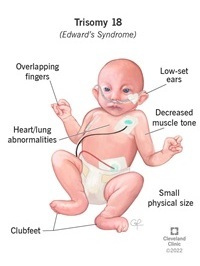
Lilly weighed only 4 pounds 3 ounces. Although she appeared small for gestational age, she did not look truly premature. She had low muscle tone, required supplemental oxygen, and needed close monitoring in our Special Care Nursery. During my assessment, I noted several unusual findings, including a two-vessel umbilical cord, clenched hands with overlapping fingers, low-set ears, and rocker-bottom feet.
It was clear something wasn’t quite right, although none of us recognized the pattern at the time.
When Naomi visited the nursery, she gently touched Lilly through the isolette opening and asked why she was so tiny. I explained what we knew and reassured her that Lilly was stable while we waited for the pediatrician.
After examining Lilly, Dr. H. consulted specialists at a tertiary care center. Initially, he wondered whether vitamin A toxicity might explain her condition, but he was also concerned about a genetic disorder. Because Lilly continued to require oxygen and had multiple abnormalities, arrangements were made to transfer her to a NICU 75 miles away for further evaluation.
Naomi returned to the nursery frightened and in tears. She sat beside Lilly’s isolette, singing softly and holding her tiny hand around one finger. Before the transport team arrived, I wrapped Lilly in a blanket so Naomi could hold her one more time.
The NICU team quickly assumed care, placed an umbilical artery line, and prepared for transport. The physicians discussed possible diagnoses with the parents and requested that the placenta accompany Lilly for further testing.
Naomi kissed her newborn goodbye, and within minutes the team was gone. She was discharged the following day so she could be at Lilly’s bedside.
Weeks later, chromosome studies confirmed that Lilly had Trisomy 18 (Edwards syndrome) along with a congenital heart defect. At the time, the condition was rare, occurring in approximately 1 in 5,000 to 6,000 births. Today, Trisomy 18 is often diagnosed before birth through prenatal testing. This can be done with Chorionic villus sampling (CVS) or amniocentesis.
According to the Cleveland Clinic, Trisomy 18 is a severe genetic condition that affects fetal and newborn growth and development and is associated with multiple congenital abnormalities. Many affected infants face significant cardiac, respiratory, feeding, and medical challenges, and survival beyond the first year remains uncommon.
Facing a Trisomy 18 diagnosis is scary and extremely overwhelming. Many Trisomy 18 pregnancies result in miscarriage or fetal death. There are resources available to help guide parents today. Following is a link to the Trisomy 18 Foundation. https://trisomy18.org/
Photo credit: Cleveland Clinic website accessed 10/16/2026