
Scary 1975 Breastfeeding Policy
This story is about
VINTAGE Breastfeeding information
NOT Current Information
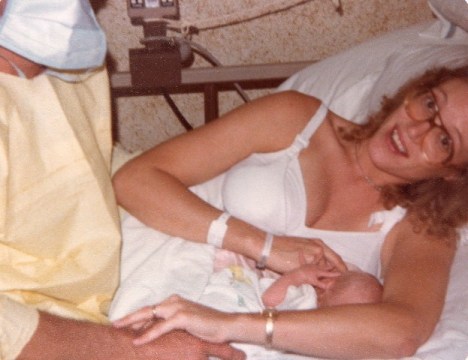
1979 Father wearing gown and mask to attend feeding
I have attempted to give an overview of our Maternity Ward as it was when I started to work there. I mentioned how “Once delivered, the baby went to the nursery and became the immediate property of the nurses, only to be seen from a window and allowed to be with the mother at token intervals. The poor little baby was often keep without food/ only water for the first 12 hrs. (Breastfeeding was something only the hippies did.)”
The thought process, as I was instucted even in nursing school, was that most newborns needed to rest after birth, and didn’t require food for 4 to 24 hours. They felt that postponing food would allow time for the mucous to be cleared from the throat and the baby would be allowed ample rest after the exertion of birth and all that handling by doctors and nurses as they provided the necessary care. My nursing school textbook (Marlow, Pediatric Nursing, 4th ed. 1973) even goes so far as to say that this lag time would allow the mother sufficient rest before giving her infant the breast because….. this first offering is…… difficult. ( Oh… You’d better rest up, dear…)
Another thought process that unfortunately is still around today was that the nurse should not encourage the mother to breastfeed over bottle feed…. least she arouse or cause any maternal guilt feelings. My old textbooks all did list some basic benefits of breastfeeding and proclaimed this as the ideal food. Ie: easier to digest, natural diet for the newborn, convenience, availability AND the provision of identified and unidentified substances which may be protective. The nurse should provide the information to the mother but not encourage her. They felt prepared formulas (Evaporated or whole milk formulas with added carbohydrates) OR the newer commercially prepared formulas were an “equal” substitute. We did have a full formula preparation room in the nursery with a refridgerator, range, sterilizing equipment etc. When I started, the Similac and Enfamil reps had already just hooked up the hospital with the marvelous free individual bottles of their products which were piled high on top of the former work area for formula prep. I don’t know when they actually stopped making it themselves.
Our 1975 Hospital Policy & Procedure *
- We start with NPO (nothing by mouth) for 12 hours. Then feed one feeding of sterile water to confirm the infants ability to swallow.
- If the baby has excessive mucus secretions, he should be fed 5% glucose water (G/W) every 4 hours for the next 12 hrs before his first breast feeding.
- The father may be present for feedings provided he is properly gowned, wearing hat and mask and has scrubbed hands.
- For the first breast feeding, teach the mother to cleanse her nipples with the cotton ball (soaked in a Benzalkonium chloride solotion) and teach proper latch-on techniques where-by the mother should cradle the baby near her breast, stroke his cheek so he turns and assist him to “grip” the nipple when he opens his mouth. Place the baby at both breasts for no longer than 2-3 min each side to avoid sore nipples. Feed the baby 5% G/W if he is still hungry when removed from the nipple.
- Feedings should be every 4 hours, the mother should cleanse her nipples as above before each feeding.
- If the baby should cry within 3 hrs of his last feed, he may be offered more 5% G/W.
- The time spent at breasts should gradually increase to 3-5 min each feed for the first 2 days then continue to increase up to 10 min each side by the 4th day. When her milk begins to flow and the baby will actually be receiving milk.
- Instruct the mother to pay close attention to which side she began and ended each feeding so she can alternate which side to begin the next feed.
- Babies will usually require 6 feedings a day for the first several weeks.
- Once lactation is established, she should be instructed to limit a feeding to 20 – 30 minutes total per feeding. The baby gets 90% of his milk in the first 5 minutes, any additional time is for his enjoyment. Some babies may “cling” to the breast after feeding and may need to be removed. Teach the mother to use her finger gently in the babies mouth to break the suction and remove him.
- Babies may be taken to the mother for a breast feeding “on-demand” if so written on the chart by the physician
If we were unable to get a baby to latch on, we had one tool available to us at the time. We had a hard rubber nipple on a glass base shield that we placed over the breast/nipple and we used the same timing of feeds. We would only help a mother pump her breasts if she was engorged. The only tool we had to assist her with this was a bicycle horn hand pump.
There were some pediatricians who were starting to be flexible and improve the approach to breastfeeding in a more natural sense, encouraging initiation earlier and more frequent feeds “on-demand”. There were more professionals opposed to that train of thought and continued their same practices. When the women started coming in and requesting a better approach to feeding…. they were sabotaged by the nurses who then fed their infants “white water” while in the nursery so these babies would sleep until the next designated feeding time.
This was 34-35 years ago and I still work with nurses today who have some of these thought processes behind what they do. Many of the older physicians, if taught anything in Med school, were taught similar management protocols. It is such a difficult retraining, re-educating process that some of us face.
Just last week.. a brand new RN/BSN asked me how the newborn was supposed to survive on colostrum alone?


