Skip to content

Posts tagged ‘support’

Repost~ The Guilt trip~ Breastfeeding, Bottle-Feeding and…. Somewhere In-between…. Why the Guilt?

There has been so much discussion circulating in the blogosphere right now about breastfeeding.  I thought I’d add my 2 cents because….I have an opinion and….. I have just a little experience in this field both in study (2 year Lactation course, IBCLC for 10 years, current CLC) and in practice (35 years).

I thought I knew so much in 1988 after nursing 3 babies and assisting others for nearly 15 years. I actually thought I could just take the IBLCE exam based on my experience!

I was so ignorant and naïve!

I started to talk to some IBCLC’s and my eyes were opened wide to the real world. Up to that point, at that time, (I sadly and guiltily admit) I had no idea about the volume of study and research in the field of lactation. I had NO idea just how wrong we were doing things at my hospital.

I launched into a lactation course, soaking up all I could, 3 years of study preparing for certification. I set out to change the world… at least my world. I wrote big proposals for the hospital. I applied for grants to fund a lactation program. I developed education competencies for the staff. I started breastfeeding classes. I thought everybody shared my passion, that they too would want to learn …. because I was right!!

Instead I was the target of all the boob jokes you could think of and I had almost no support. My ideas were rejected left and right.

Long story short…it took me a long time to come to terms with accepting small changes, taking baby steps…..continuing to do the best job I could with each mother-baby couple and to keep a positive outlook. I needed to remain realistic about how much I could actually accomplish one step at a time. Slowly I began to have people under my wing trying to learn. Yeah!

I learned a lot about how to approach physicians, co-workers, managers and most of all …. mothers.

I am not an expert in journalism or critical analysis so this is my opinion of what is going on right now.

There have been some irresponsible journalists, those who have a bigger platform than most of us, writing negatively about something they have not studied or truly researched. They are expressing their opinion and including an emotional component which has, in my opinion, gotten the reaction they hoped for from breastfeeding advocates as well as those who concur with the authors. More hits, more readers. I feel they have twisted the facts to benefit or support a point they want to make. I read some of them.. other’s I really just scanned then brushed off so I don’t know everything that’s been said. On the positive side, these articles possibly give us a larger platform to provide correct information to a larger public in reply.

I read a lot of blogs and I really respect and admire all the research that many breastfeeding advocates put into their fabulous posts. These are educated women who are trying to provide current accurate information! (@phdinparenting, @bfmom, @MommyNews , @JakeAryehMarcus, @blacktating ,@AmberStrocel, and so many more). I applaud their passion and breastfeeding advocacy. They are doing a very important job. Breastfeeding IS very important and deserves advocacy, protection and support! There are still large scores of women out there making choices with only tiny bits of information, who really do not know the important benefits of breastfeeding. It is because of this, and because we still haven’t met the US Dept HHS Healthy People Goals for 2010, that breastfeeding advocacy needs to continue. I have been there, advocating in a time where I faced great adversity and a lot of negativity. I am bothered that it still exists…and exists now in so many new ways.

I am more disturbed that some mother’s out there are upset. I always try to understand just WHY a mom feels guilty if she chooses to formula feed or do some combination of formula and breastfeeding. I always hope she’s made her choice with good information and that it is her own true choice. Then good for her! I am not to judge. She needs to be comfortable and confident with her decision. Perhaps her guilt comes from how one single little word or sentence was said, even if what was said is accurate and true. Perhaps her guilt is coming from her own internal struggles. I don’t know.  She needs to come to terms with that herself,  and not punish herself and or publicly criticize the advocates saying they are causing the guilt.  Although there are some very zealous advocates out there, I feel in my heart they are not trying to make any individual mother feel guilty. I read a comment from a mom somewhere that said something like… “perhaps if moms knew it wasn’t all or nothing, maybe more would try breastfeeding.”  My first thought was..why do they even think that..are there really mom’s who feel it has to be all or nothing? Is this causing the guilt because they don’t think they can breastfeed exclusively for the first 6 months as the experts recommend??

Over the years, I have learned this:

  • It is inappropriate for a health care professional to indicate to a mother directly or indirectly that formula feeding and breastfeeding are equal. Human breast milk is the superior food for human infants. Properly prepared infant formula is an acceptable substitute for those who cannot or choose not to breastfeed.
  • The first approach is probably the number one factor in gaining a mother’s interest in what you have to say.
  • The education process to a mother needs to be in small doses, sensitive to her unique learning abilities, her cultural beliefs and practices and most importantly, her choices and individual breastfeeding goals.
  • With that in mind, try to provide her with the information she needs to make her decision.
  • Never overestimate a mother’s desire to breastfeed her infant.
  • Never underestimate a mother’s desire to breastfeed her infant.
  • Listen to the mother; help her define her true desires and goals.
  • Many times, the first question she asks may not be what she really wants to ask.
  • The mother’s individual breastfeeding goals, how she defines them, how important they are to her and how she relates them to her actual breastfeeding experience all help define how she measures success.
  • Support the mother, support the mother, and support the mother.

Here are the top 3 responses to the feeding choice question pertaining to breastfeeding at my facility on admission:

  • “Breast and Bottle”
  • “I’m going to do both”
  • “I’m going to ‘try’ to breastfeed”

To each of these I respond very positively with something like… “Great! Tell me what you’ve learned about breastfeeding.”     I will then ask the mom a few questions to somehow find out her true wishes.

Then I say  “We will support and honor however you wish to feed your baby.  I’d like to give you some information so you can really understand and then tell us what you’d like to do.”

I explain some things,  i.e.: how the milk production works, the importance of early feeds etc.. and how formula introduced at that time could  interfere with the process of production, the baby’s ability to latch properly and so on… I usually end with..”We usually recommend to  focus on breastfeeding for now and then offer bottles later after milk supply is established if that is how you’d still like to manage feeding”. ETC…ETC….  Here’s what I then see:

  • There have been so many mom’s who — after a little  bit of information decide they would like to focus on breastfeeding. There have been many who totally fell in love with it.
  • There have also been many who really didn’t want to breastfeed after one single feeding.
  • There are many many still that like to breastfeed and bottle feed in combination right from the start. If they have the right info and understand how things may progress… I still say “Good for you!”
  • I have seen many continue that way for months and they are very happy with that.
  • I’ve seen many mom’s “partially” ( I don’t like to say it that way) breastfeed and feel very proud. I say “good for you!”  They don’t think of it in terms of “exclusive” or “partial”… It’s more like any breast at all…. is breastfeeding vs. no breastfeeding at all.
  • There have been many who also never wanted to try until all of a sudden they see milk leaking!
  • I’ve worked with mom’s where I can see tremendous improvement in her situation, I think she’s going to keep going…but she decides to totally quit. I simply praise her for all her efforts and help her feel proud of herself.
  • I’ve worked with mom’s who have hardly put forth any effort to overcome small obstacles, I think they will probably quit outright… Then..I find out they are the ones exclusively breastfeeding down the road.

I got a comment from a breastfeeding mom @TheFeministBreeder that I absolutely have to share. She describes her own experience in the full comment and on her new blog post.  She comments:

“Yes, I think that’s the most important part – informing a mother of any and ALL benefits/risks to supplementing, and helping them work through the option they choose.  But to tell a mother to supplement without explaining that it could undermine her efforts is just plain mean.  And too many medpros are doing it.  I’m glad there are more nurses like you who will give out the real information to empower a woman to make her own choice.  My smart friend always says ‘It’s not really a choice if you don’t have all the information.’ “

For those mom’s really trying to breastfeed and struggling, there’s more than I can say right here to cover that. I’m sorry for your struggles and hope it gets easier for you. It is important to have a skilled competent support person assisting you who listens thoughtfully and helps you get to the root of your problem… and helps you define and realize your goals. If you are experiencing guilt from your struggles or from not being able to fulfill your goals, desires to breastfeed….I think that kind of guilt is different from what I’m trying to discuss here. I am not a an expert on that. It is valuable to get the best help out there that you can as soon as possible.

I’m adding this after reading some comments on other blogs.. When approaching a mom to observe or assist with the latch process…. Permission is a must! I ALWAYS ask the mother if she would like any assistance with the latch or if  I may observe how well her baby is latching….. If that answer is yes… The next question is ALWAYS.. May I touch your breast? (if that needs to part of the process). I prefer to help moms by having the mom and BABY do the latch. I try to keep my hands out of it.  All nurses and LC’s should practice this. I am sorry for the mom’s who aren’t asked permission to be helped or touched.  😦

One of my favorite things I like to say to any breastfeeding mom is:

“Try not to make any final decision when it’s dark outside”.

On another note, regarding some reader comments on various blogs about public breastfeeding, a skimpy bikini or the bathing-suit issue of a favorite sports magazine show more skin in a provocative, sexy way than any mom breastfeeding. Even the movie stars in their gowns with plunging necklines are showing almost the entire breast! Somehow, that is OK. There are volumes of video footage and photos all over the place… even on billboards. It is sad that the public opinion of a baby breastfeeding (the most natural way for him to eat) is something that should be done in private … yet young girls are encouraged by media to bare more and more skin. Of course being discreet while feeding is important, but I can assure you, most girls in a tiny bikini are thinking more about “tacky exhibitionist behavior” than a mother breastfeeding her baby. Why aren’t law-makers focusing on any of that?

My Breast Pump and I didn’t get Along 

Can I Pump my MILK?  Should I? …

or  Not.  Even.  Bother.


My Own Struggles with Pumping and Working

and doing what worked for me

Welcome to September’s Carnival of Breastfeeding!!!

I have this post AND an additional post All about Pumping including choosing a pump and how to Practice Pumping before going back. After you read this, check out the other posts on this month’s theme of “Breastfeeding and Work” linked at the bottom of this post. All links will be added as I get them hopefully by the end of the day Monday, so be sure to check back for the full list!
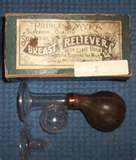
breast pump

A little history

As far back as I can remember, the only breast pump we had around in nursing school or when I first started working on the maternity unit was this thing that looked like a bicycle horn. This picture above is for an old “Breast Reliever”. It is glass with a rubber bulb to squeeze for suction. This particular antique is from the earlier half of the 20th century. We actually had a similar type glass model in Nursing school and on my 1st OB unit in 1974.   Historical use of breast pumps shows the first patent was issued in the 1800’s and a patent for a mechanical version was issued in the 1920’s. Information was scarce then. Not too many nurses knew much about it.  Mother’s were instructed to use it if they got engorged. I can’t believe it would have been very helpful.

pump70sold horn pump

We got a newer plastic version of this pump in the 70’s but still didn’t have any clear instructions for use. I was never taught by instructors or fellow nurses, so all I could do for the patients in my care was review the instructions on the box with them! I don’t even remember what that said. Those old horn pumps were trouble. They were traumatizing to the breast and the rubber bulb was just a trap for bacteria.

I remember one mother in particular in 1975 had been readmitted with bleeding, gone to the OR for retained placental fragments at 2 weeks postpartum. She was breastfeeding and having trouble. I took care of her postop. She said “I can’t believe how much milk I have, what can I do?”  I promptly went for the only pump we had and went over the directions with her. She was saying it hurt but felt better at the same time because it did help to drain some of the milk.  I didn’t much know then about how the retained placenta can delay hormonal shifts and your milk coming in. She and I both thought at the time it was because of being separated from her baby!

ANYWAY

By the time I had my first baby in 1979, (YES- 30 years ago) I had become more familiar with pumps because I had a friend pumping and now I was very personally interested. I wanted to pump just like her! I want to store milk for my baby when I went back to work. Her baby was 3 months old and she had gone back to work. She pumped in front of me once to show me how easy it was. She used a cylinder style hand pump similar to this picture. She got 8 ounces of milk in about 10 min!
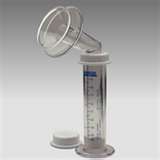
70s pumpIt had one chamber inside the other. To pump, you would place the cone over your breast and pull the outer chamber up and down. This was a very popular style pump at the time. Easy right? I promptly went and bought one! I can do this!

My son was born weighing 6 lbs 9 1/2 oz. Breastfeeding got off to a great start, there were no problems at all. I was very confident about that and had great support from my best friend. My son weighed 7lbs 2oz at 2 weeks and nearly 10 lbs by 6 weeks.

I had plenty of milk!

None of which hit the bottom of the chamber when I first tried to pump….  no matter what I did! I knew nothing about the technique of pumping. I worked and worked at it.  I could playfully squirt milk across the room. I had squirting contests with my sister. We cracked up laughing! I could not get any milk with the pump.

I had never practiced. I thought that once I was away from my baby, I would just pump… thought the milk would just come out like my friend. I went to work, let myself get a full feeling and tried. Nothing.  I woke him up when I got home and made him eat!  The next day… same thing.. Nothing.  Luckily I only worked 2 days a week so I nursed him all the rest of the time. I kept trying- week after week– I thought I just had to get used to it. I am sure I was very stressed each time, never using any of the tricks I teach moms today.  I still never thought to practice when I was home with the baby. The most I EVER got after 45 min of pumping was one ounce.  I gave up and only fed formula while at work. My body adjusted and I was happy doing what I was doing.

I wrote a guest post over at Breastfeeding Moms Unite on pumping including choosing a pump for you and practicing to pump. All moms are so different and many have no trouble at all expressing their milk. Others have  trouble releasing their milk to this plastic “thing” on them that doesn’t feel like their baby. It’s just not the same! In that post I say:

I have found it’s important for mothers to understand that pumping is a substitute for the real thing and that it takes practice for lots of moms. I always say to expect hardly anything the first time you try then whatever milk you may get is wonderful! One very important point to realize is that whatever you see come out with a pump or hand expression is NOT a reflection of how much a baby gets in a feeding when he is well latched and effectively feeding.  What you see come out with the pump is what your body released at that moment in time. Even women with a great supply and healthy growing babies can have trouble learning to pump. The baby is the master … you are merely trying to imitate him! The type of pump used and when you pump in relation to the age of the baby as well as the time of day, frequency etc. can have a big impact on your results.

My second baby was born in 1985 . Another 6 pounder at birth with rapid weight gain, a great milk supply for me.  I had some improved pumping results with him partly because of better pumps and mostly by sheer determination to help him heal through major surgery at  3 months. The Children’s Hospital had a hospital grade electric pump, a pumping room and directions on what to do. Because I was able to provide milk for him in the hospital, I had renewed faith in myself that I could pump once I went back to work.
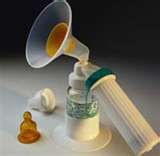
pump 80s

There were different pumps, better pumps available. I tried my old pump and some piston style pump like above. I don’t remember the name of that either. I tried many…still waiting to pump again till I had eventually gone back to work. There were some battery/ AC adapter electric ones to buy. I had one, but don’t even remember the name.  I had to push a button to make the suction go on and off –>  otherwise there was constant suction on your breast and no control on the degree or amont of suction. Some people told me to keep the suction on till it started to flow then push that button on/off.

Well it didn’t flow, it hurt. I never released any substantial milk for any of these pumps. I wasn’t able to keep it up. I ended up doing the same as I had with my first son. I made a routine which worked for me of nursing all the time at home and formula when I was at work. We didn’t have any hospital grade mechanical pump until the 1990’s at my hospital, long after my third baby and after I became a Lactation Professional.

I had dealt with so many other issues after my third baby that pumping was never much of a thought in my head. I simply fell back into the routine that had worked for me with the first two babies. She is the baby that nursed the longest even after I went back to work!

Looking back, I think if I had access to the information I know now, and the availability of today’s high quality pumps…I might have, possibly would have had better success pumping. The most important point is that I still felt successful  and was happy with my breastfeeding relationship for all my children!

After all, I could squirt my milk the farthest!!

😉

More Carnival Posts:

A Wonderful Day in the BirthingHood

What a great fun day in the world of birthing.
The first words I heard at work today were words that I just love to hear when used in this sequence….

“Section’s Canceled”

Hooray!

Her Cesarean had been scheduled because her baby had been in a transverse lie position…. for weeks.  However–> this smart little genius baby had positioned his little self into a beautiful head down position before arriving at the hospital this morning! Mom was also contracting regularly and was 3 cm dilated. This was her second baby, first exam of the day, so she hung out for a while until it was clear she was continuing to make cervical changes and labor was underway.

A few others decided it was their time to make an appearance today. One baby boy was a couple weeks early and another a few days over 41 weeks.

Ever hear that things sometimes happen in 3’s ??

 As luck would have it, 3 young men decided to be born within 15 minutes of each other! All 3 were spontaneous vaginal deliveries. All 3 boys were breastfeeding within that first hour and 1/2 … not bad!

All the moms were so happy with their birth experiences. All the babies were healthy. The staff worked really well together. Our midwife was awesome! The doctors were fun, funny, thoughtful and kind and made really good patient centered decisions.

It was just an all around wonderful day in the birthinghood!

005


Prescription and Herbal Galactogogues

033


Gotta make more milk!

I have compiled a literature search of the most common presription drugs and natural or herbal galactogoues used for low milk supply.

Check out my comprehensive guest post over at Breastfeeding Mom’s Unite here! I would love for you to visit her awesome site and leave a comment for her (and me)!

Thanks!

Initial Low Milk Supply: A Breastfeeding Story – Case Study

034     The History:

 One typical busy morning coming on shift, one of the couplets I received report on was a 3 day post-op C/S mom and baby who were scheduled for discharge this same morning.  She had been a long 3 or 4 day failed attempt to induce a vaginal delivery for fetal macrosomia (big baby) at 40 5/7 weeks before the C/S.  Lots of IV’s, lots of Pitocin… all before the birth.

Her baby weighed 10 lbs 4 oz at birth. We got in report that his glucose sticks had all been over 60 initially so they were stopped early on. His exams were normal.  His total bilirubin this AM was 11.3 at over 72 hours of age. He was “breastfeeding only”  (*sigh*from the nurse giving me report).  She then expressed a concern that  he was down 10% from birth weight weighing 9 lbs 4.5 oz today.  When I asked her about the feedings, she said he’s been nursing beautifully all the time but nobody’s had time to stay in the room and watch him feed. I asked about the output and she reported he’s been voiding, the last stool was a couple shifts ago.  Then the nurse added “We told her you were here today, Melissa, she has a lot of questions for you. ”

I was able to juggle some things around, have staff cover some of my other responsibilities temporarily to make this a priority. Since I am a general staff nurse, there are often more pressing situations. Fortunately, today I was able to manage the time to see her right away.

I went in and introduced myself to Meg*, Brad* and their son Mikey* (*names changed). They had indeed been waiting for me.  Breakfast was underway and Mikey was asleep in his crib. I asked her a few general questions in a relaxed manner about breastfeeding first to try to establish some background: Mikey’s energy level, drinking pattern, feeding frequency, and diaper checks.  It is important to gather information and observe the feeding  in the process of  a full evaluation to determine adequacy of feedings.  The information I got was concerning.  He spends a lot of time at the breast, falls asleep quickly, not very energetic with every feed, not much change in her breasts at this point and no stool since yesterday. I did not tell her I was concerned at this point, nor did I mention the weight yet. I asked if I could check him now and if  it would be alright if I observed the next feeding.. We determined that should be with in the next hour. I talked about feeding cues and asked her to get me if  Mikey seemed ready to eat before I came back.  His vital signs were normal, jaundice not too significant for his age, diaper contained a small amt concentrated urine, and Mikey went immediately back to sleep.  I felt he was OK at the moment and needed to go do a few other  things with other patients.
 
At this point I am feeling pulled in different directions because Meg’s situation could easily take hours of my already busy morning. I am upset that this has possibly been going on the last 3 days and hasn’t been evaluated properly, now it’s day of discharge! How do you do the proper evaluation, give the needed gentle support, make possible feeding plan arrangements in fragments of time? This is what I am trying to change…in my opinion, we the hospital, helped contribute to this situation of possible inadequate feeding and supply… we need to help her! I talk to the charge nurse and it’s cleared to keep my coverage the rest of the morning.. good thing L&D was quiet!
 
Mikey’s doctor comes in and thankfully it is a partner who is very pro breastfeeding and open minded to try options a mom may choose. I gave her report on his physical status, VS, weight, earlier glucoses, and the Bilirubin. I summed up my plan to evaluate feeding quality but suspected he has been ineffective at the breast & milk supply/production may be delayed. I added that I was going to check his glucose if he had low energy level, and encourage pumping or expression for the mom and get that milk into the baby as well as encouraging her to stay for a few feedings to work with me. The MD was happy with these ideas but requested he be supplemented (complemented) with formula at all feedings now until his weight came up. She supports the theory (as I do) that the birth weight can be somewhat inflated with all the pre-birth IV fluids mom rec’d and some of what he lost may be fluid.  The MD said that if things were better by afternoon, he could go home. She went out to examine him at mom’s bedside.
 
I went in for my feeding observation a little while later. Meg now knows his total weight loss and feels very upset. I give her a lot of support and agree with the doctor that some of that could be fluid. I then find out..Meg is an RN here at my hospital on another floor! It had not come up in conversation! So now I know she is even more worried because we nurses always think the worst! I do my best to think simple and encourage her to do the same… it is very early and we can turn this around quickly with a strong approach.
 
My Evaluation:
  • Good independent maternal positioning, holding and offering of the breast
  • Nipples erectile, breast tissue soft, pliable, small amts colostrum expressed–> mom reports her breasts were “swollen first 2 days”
  • Latch fairly adequate but not optimal-> improved greatly with football position and instruction on asymmetrical latch approach (I’d like to say here that I have a” if it’s not broke don’t fix it” attitude. I don’t correct a latch for a mom who has no pain and good milk transfer, we talk about it in case it may come up for though)
  • Mikey very sleepy at breast, difficult to maintain latch, no milk transfer observed–>breast massage during feed tried without improvement
  • Due to continued low energy level (suspected caloric deprived state causing sleepy ineffective feeding behaviors) a bedside glucose was checked. Result was 49.
  • Diaper dry–> the previous concentrated void was only his 2nd in last 24 hrs No stool last 20 hrs and that one was dark.
The mother’s feeding plan:
Many options and teaching points discussed with Meg including the need to boost caloric intake –>starting right now, methods to get her milk or formula into the baby avoiding bottles, a vigorous pumping plan to augment breast stimulation, alternate breast massage, how to observe for swallowing and milk transfer at the breast etc.. I also discussed with her how in my experience, sometimes it is like magic once the baby regains up to birth weight… they just take off!
She chose:
  • Cup feed formula now while she pumped –>Mikey would not cup feed so we used a syringe, 18 cc, repeat glucose 62
  • Pumping round the clock, double pumping –> Meg rented a hospital grade pump for home use
  • Keep close eye on feeding cues, put Mikey to breast in football w/ latch process discussed earlier
  • Closely watch signs for milk transfer, correct feeding activity while at breast, sucking rythym 1 or 2 sucks /swallow ( Brad was very involved in this process of learning the observation techniques)
  • Use breast massage/ compression while baby @ breast through feed to increase milk transfer
  • Goal of min 8 effective feeds in 24 hr..wanted to try for 10 –>agreed to feed expressed milk or formula 1/2 to 1 oz after each feed first 24 hrs until re-weighed next day
  • Have as 1st 24 hr goal:  to see 3 -4 increasingly wet/clearer diapers and at least 2-3 good sized stools
  • Return to MD for F/U bili and wgt check next day
  • Call IBCLC for eval in next few days if weight not adequate and not independently breastfeeding/output  within safe parameters for age

The follow up reports:

  • DAY 1 (In hospital) Mikey fed 3 more times in the hospital at 2 hour intervals.  Each time he had about 15 to 20 cc of formula by syringe. Each feed was improved but not adequate quality of milk transfer. Meg pumped 4 times before discharge not getting much first 3 times but 4th time she got almost 10 cc! Mikey had 1 conc wet diaper and a med sized dark stool. We re-weighed Mikey prior to discharge and he was 9 lbs 5.5 oz.  Meg left the hospital late that afternoon while I had been called to a STAT C/S. She was determined to go home after all the time she had been there! I called her later and she was on target with her plan.
  • DAY 2 (first 24 hrs home) Seen at Peds office. (reported to me from MD)  Bilirubin 10.6, weight–> 9 lbs 7.5 oz! Baby more energetic, better quality feeds reported. Meg still power pumping, now getting 1 -2 oz per pumping and giving to baby with syringe and only used formula occassionally if no breastmilk.  Had 3 wet and 2 stools since discharge, stools lighter in color. MD arranged F/U weight visit for 2 days, will arrange IBCLC if no strong improvement before 2 more days
  • AGE 6 1/2 days Seen at Peds office. (reported to me from MD) Weight–> 9 lbs 11 oz !!! Meg having fairly same routine but not always pumping if she feels Mikey had good milk transfer. She reported increased  breast fullness, 6 wetter, lighter urines and 4 mostly yellow stools in each of the previous 24 hr periods.
  • AGE 2 weeks  I don’t have MD office reports but Meg called me to tell me Mikey was 1o lbs 7 oz at his 2 week check up and nursing a lot better EVERY feeding!! She was still attached to her pump, gradually decreasing the sessions, just felt safer to keep going with that. If she gets milk she was still giving it to him. This was her security blanket and she was happy doing it. She was very proud of herself and crying happy tears! 🙂

Meg’s case was a beautiful example of HOW a situation can turn around quickly.  An individual mother’s determination coupled with a productive plan can produce these results. All situations are different.

Every mother and baby deserve our best!

HomeBirth Transfer~ Doc says NO to C/S~

I wrote a few stories a few weeks ago because I was proud of my hospital that week– sorry I didn’t finish the stories until now……

iStock_000004564778Small

~She lived about 8 -10 miles outside of town. “Ellie” was having her first baby at age 32.  First baby, first pregnancy, no risk factors…. an easy uncomplicated pregnancy. She had done some research, not extensively, judging from some of my conversations with her and her husband…but she knew what she wanted. She had made a beautiful plan with a CPM for a water tub home birth. This particular midwife has been doing home-births in my area for a long time.. (She was the one cowering in the L&D hallway in this story…). The story of how things progressed up to transfer to the hospital was told to us by both the mother, father and midwife. 

~Her labor started with regular contractions at 39 weeks. They progressed from early labor which lasted around 6 hours to a more active labor with contractions about every 2- 3 minutes.  Her cervix had dilated to 6-7 cm. This pattern of contractions continued for hours. Ellie was in and out of the tub, walking, dozing, in and out of the shower, squatting, doing many different position changes throughout the next 6 to 8 hours. When she was re-examined by her midwife, she had made no cervical change in all that time. This can happen sometimes, things can stall out and pick back up again. Ellie reported that the contractions may not have been as strong at that, so she wanted to wait it out, maybe nap. The baby’s heart rate checks were all good.

~Everyone rested about 2 hours … Ellie’s water broke (clear fluid)  about 1 am and her contractions got more intense. The CPM checked her cervix about 3 am and felt no change. She still was 6 -7 cm dilated and the head was at about -2 station. The midwife then brought up the idea of possibly transferring to the hospital. Ellie said NO! Is my baby alright? “Yes….” said her midwife.. “Then No..I’m staying here, — I can do this.”

~Back to the tub… In and out of the shower, total body massages.. contraction pattern the same with increased intensity…next cervix check at 730 am… still 6-7 cm. Now Ellie was tired. Really tired. Exhausted! The baby was great on all checks. Her midwife again brought up the transfer to hospital idea, talked to her about the possibilities of pitocin, epidural etc… Ellie was now wanting anything, agreeing with anything–to get this over with.

~She arrived at the hospital around 8- 830 am very upset. Her husband and midwife were with her and her CPM had all her prenatal care info. Some of the first words out of Ellie’s mouth were that she wanted an epidural and a Cesarean! The nurses on duty this morning were awesome! They calmed her down, had her hooked up to the fetal monitor and observed her contraction pattern and the fetal heart rate pattern response. The baby looked excellent! The midwife and hubby coached her through the contractions while the nurses gathered their admission data.  The doctor checked her and she was still about 6-7,  swelling of the cervix noted, about -1 station. Ellie asked him if he would please do a C/S and he said no… (yeah!).  He said that he felt the best option at this time was to do the epidural she was asking for and observe her contraction pattern… possibly add Pitocin. He talked to her so nicely and non-judgmentally. Many of the other docs would have taken her right into the OR with very little discussion of options. She had been 6-7 cm dilated for some approximate 16 hours.

~After the epidural, Ellie and her husband and midwife all slept. The doc did NOT start pitocin right away, he said that she may need to rest and the contraction pattern couldstart to become of better quality once she rested and was better relaxed. WOW! Where did this guy come from? I’m so amazed and happy and quite frankly, shocked. This was a newer OB here.. I wanted to ask him where he’d been all my life! I went in to talk to Ellie and introduced myself. I told her I was so sorry thingsweren’t progressing the way she had hoped and sorry she didn’t get to stay home. She thanked me and said at this point, she was ready for it to be over! I told her she was really quite fortunate to have this particular doctor on duty today. Except for one bad apple from the night shift just leaving when Ellie arrived, everyone was wonderfully supportive and accommodating. Ellie’s contractions indeed did start up in a better intensity pattern on their own….. however their continued to be a lack of progress.  Once again, she asked the doctor to get it over with now and please do a C/S. 

~The doctor said NO again! He explained that her uterus was probably tired and the quality/intensity of contractions just may not be what was needed for the job to get done. He explained that the fetal heart rate tracing was beautiful and her membranes had been ruptured less than 12 hours. No baby risks…  He felt it possible the baby merely needed to get in better position and the contraction quality needed to improve.. and then he would re-evaluate. Ellie agreed with renewed optimism. The pitocin drip was started. She didn’t need much before the contraction pattern got much stronger, longer and better quality.  He came to re-evaluate her only after these better contractions had been consistent for 2 hours. The vaginal exam revealed the cervix was the same ..still the same and possibly more swollen.  He said he felt the head was not as well applied to the cervix as it had been.. but still at -1 station. He examined her with and without a contraction. Same in his opinion. Ellie lost all her fight. Her support people rallied to help her, but she was now insistent.

~This time the doctor  said she certainly had reason to feel this way, had given this a great try. He told her he still felt she could try longer… that we could alter positions with the pitocin, keep her comfortable with the epidural and keep going… the baby was handling all this just fine. He did say that there was a possibility the baby had his head in a tilted position making it difficult to descend the birth canal. He then let it up to her and told her if she wanted the C/S, he would do it at this point.

~YES I want a C/S! Ellie exclaimed. We did the C/S about 3 pm… some 7 hours after transfer and approximatelyclose to 24 hours of being 6-7cm dilated. Her gorgeous 7 lb baby boy was delivered operatively with apgar scores of 9 and 9. Pink and vigorous! Beautiful. I was able to get him skin to skin in the OR.. that was one of the first times all the players didn’t object and I went with it! (It won’t be the last….and next I’m trying for breastfeeding on the OR table!) Upon delivery, the OB noted the baby had been acynclitic . This is when the head is tilted to the side, ear towards the shoulder.  It is probably responsible for her long stall in labor. The OB still felt she could have delivered vaginally given time and good management. I am just so happy he was there.  I am proud of this mom, her partner and midwife and of our whole team! This mom was able to make good educated choices about her care despite dealing with the stress of a transfer.. and was able to feel so very very proud of how hard she tried.

In the end it was her…… who gave in to the C/S … not her doctor. 

Of that we can be proud

🙂

I’m Proud of my Hospital….~ this week ~

~I’ve reason to be a little proud of the care given this week.008

I hope this is a continuing trend of attention to detail, utilizing evidence-based practices and compassion, listening to our patients and providing them with options and the best possible care…. I’ll give you a few details about each as you read on… In summary, this week we have had the following situations:

  • A 25 week-er walk-in with a precipitous delivery stabilized & tranported quickly
  • Twins! Vertex/vertex –turned breech– turned vertex~ delivered vaginally
  • A Heroin/Cocaine  addict identified, baby able to be treated appropriately so comfortable transition
  • Safe Haven newborn about 1 day old.. placed up for adoption
  •  Homebirth Transfer handled with great respect overall and most importantly, the mother is happy with her experience.

Whew! We have a lot of busy weeks but they don’t always have this intensity or variety! I feel proud because there may have been a few things done differently due to recent conversations I’ve had…Plugs I’ve made… and I keeping putting in little plugs to try to gently increase awareness & educate. I am an Instructor in Neonatal Resuscitation and Lactation.. sometimes the troops listen when I talk about other topics…. I’m no expert but I try to be current, correct and compassionate in care. (My 4 c’s)

Okay… the details for the first 3… stay tuned for the others…..

~25 Week gestation walk-in~

She came in with mild cramps and pressure. She didn’t report any fluid leakage but did C/O pink vaginal mucus. We had her in an exam room pronto. She had a gentle speculum exam which revealed hour glassing membranes thru an approximate 4-5 cm cervix..visually.  Hour-glassing means that the intact amniotic sac has protruded thru the partially dilated cervix and expanded like a bubble  in the vagina. She went right into trendelenburg. The transfer teams were called. It was soon clear she would deliver here and the baby would need to be stabilized and transferred. The NICU team contacted us back they would be flying up to retrieve. The nurses caring for her were tremendously supportive.  All procedures explained, options offered and decisions honored.  They got her records faxed over from her OB’s office so we had a little history.

Like a well oiled machine (from all of our drills), all the emergency equipment was readied, pediatrician in attendance, roles clarified. Once he was born almost without warning, precipitously, all at once, about 30 minutes later. He was quickly assessed, wrapped in plastic, ventilated, then intubated. We had a peripheral IV in place in case he needed meds or fluid volume. He had a chest xray and a blood culture/blood count sent.  He was kept warm, ventilated and appropriately oxygenated and had stable glucoses. He weighed in at about 700 gms (about 1 1/2 lbs). The team arrived when he was about 30 minutes old. They checked all labs, xrays and his IV line. They gave him Surfactant and pretty quickly and carefully,  loaded him in the transport incubator then got him out to his mommy for a visit before he was transferred. They answered all her questions before they left and we helped her deal with it all. The doctors discharged her shortly after that so she could get down to her baby.  At last report, he was doing just as expected for 25 wks, no other complications often seen at that gestation, for ELBW (Extremely Low BirthWeight) had come up. He was actually improving each day! So happy for everyone!

~Twins!~

She came in to the hospital already in very active labor at 37.5 weeks gestation. Her twins were both head down (vertex/vertex). She labored quickly, uneventfully and delivered Twin A at about 1 pm. With the ultrasound machine in the room, they scanned over her still pregnant belly to see where Twin B was and if he was still in position. Turns out that once Twin A had vacated the womb, baby B had a lot of room and he had moved into a transverse/breech position. That means he was more bottom first than head first anymore. Most Ob’s now don’t attempt a breech delivery even with the second twin.  They are quick to do a C/S…. This day, however, …. the Ob in charge called over an associate to ask his opinion. They brought the mom into the OR and prepared to do a C/S  if they were unable to get the baby in proper position. The point is they were at least going to TRY!  With the U/S scanner and 2 assistants, they did an external version and worked Twin B  back into a head down vertex position without complication. He delivered vaginally about 1 hour and 45 minutes after his brother! The staff kept the first twin in the room the whole time so they could all be together. I spoke to the Ob later and congratulated him on a great job.. he said to me that he remembered what we had talked about awhile ago (when I had written the post about a C/S for the 2nd twin), and had researched it himself. I was happy that any little plug I had made had sparked interest in researching the topic and possibly even influencing a decision towards better care! I am happy to report that both babies went home with mommy on day 2!

~A Heroin/Cocaine addict~
We are attempting to put together some consistant protocols for drug screening so that we don’t miss the opportunities to protect a newborn in need…. Some may not understand how important it is to sometimes screen the healthy and innocent to weed out those with problems…. They don’t always present in an obvious way. From my perspective, those individuals who are hiding something are very difficult to identify from outward appearance only. We identified a heroin/cocaine addict recently who was a very beautiful, well groomed, well nourished, affluent (seemed wealthy) woman who stated she was just visiting in our area, and had no prenatal care info or records with her…. she was in rip-roaring very active labor at 36 1/2 weeks with heavy vaginal bleeding and fetal distress. We thought we were headed to the OR but the baby had other ideas. We had little time to get more information before the baby was born. There was a small abruption but luckily, the baby was vigorous and did not seem to have suffered blood loss. The admitting nurse had collected a urine sample with a catheter insertion and sent it for drug screen. It came back positive for Opiates, Cocaine and THC. The baby’s urine also tested postive for Opiates, Cocaine and THC. Because we knew, we were able to start the NAS (Neonatal Abstinence Scoring) for signs of drug withdrawal and identify the signs quickly. If the baby is unable to be comforted by swaddling or holding or if we had 3 scores of 8 or higher, there are protocols set up for medicating the baby. The baby did require medication within 24 hrs. Once medicated, she was such a happy sweet little girl. The nurses named her “Molly” and we all loved her. She stayed with us all week until the pediatrician released her andChildren’s Services placed her in a foster home experienced with this kind of care. Unfortunately, some of the big drug problems have hit my area. Our local paper just did a big series of stories on local Heroin addiction problems. Apparently it is cheap and accessible.

I am going to publish this part tonite and tell the other two stories soon…

OB Docs and Nurses Scoff at Homebirth

My community hospital’s views have never been in favor of any type of home-birth… whether it’s with a skilled professional  practitioner or a skilled lay midwife. There could have been some free unassisted births going on but we were not aware….  As I grew-up in this profession, I learned first from my experienced counterparts…then I began to educate myself and learned a lot from mothers and babies.  The doctors and nurses I worked with were all stagnant in their knowledge in my early years. They were satisfied with how things were.  I was young, I had an open-minded philosophy and an eager quest for knowledge.

In the later 70’s, just when we began to have mothers speak out and request a more natural childbirth, I had a few friends who enlisted the aid of some lay midwife in the region and arranged for homebirths. They all had a really nice birth experience without a single complication. Perhaps that was why I was open to the idea even though I was not personally involved. Besides some of the truly prepared couples who came in and had incredibly beautiful births….. that had been my first exposure as an alternative option to the knock’em out–pull’em out births I had been working with on the job. I knew my friends were very low-risk and had done their homework. 

   However, the hospital’s exposure to a homebirth in those days was only if the homebirth went awry for some reason or another and they came in our doors seeking help…  here’s what the docs and nurses would say to one another :

  • “Can you believe she planned to deliver at home???”
  • “How could she take take a chance like that with her baby?”
  • “The reason people started coming to hospitals to give birth was because mothers and babies were dieing at home….she must be crazy or totally insane!!”

   We’ve had planned homebirths come in for various reasons, as I am sure other facilities did…. (keep in mind that in my area, the usual birth attendant was a lay midwife). The situations bringing the mother to the hospital were often scary and upsetting for her. The most common were:

  • Fetal heart rate decels with or without meconium stained fluid 
  • Lack of progress with pushing mostly after many hours..
  • Higher than normal bloody show or bleeding–possibly abrupting
  • Breech, brow or face presentation
  • Retained placenta

Often the OB’s didn’t handle themselves well.. certainly not professionally. We had this one OB who would call for the OR to be opened before he even examined the patient or evaluated the situation…..regardless of why they came in.  And he often actually yelled at the mother, in the middle of her scary situation.

“Your baby will die if we don’t do an emergency C/S right now, why did you let this happen!”

Most often the backlash was directed at the midwife who cowered in the hallway- uninvited by the staff, left alone detached from her patient. She never left the unit though until she was afforded the opportunity to visit and speak to her patient. 

The two significant situations I remember which would fall in to statistical data for morbidity were:

  1.  An abruption which resulted in a crash C/S upon admission and a neonatal resuscitation with good response….(final apgars 3@one min then 7@ five min) positive overall outcome, no long term sequelae.
  2. A birth where the father (a chiropractor) was the birth attendant for his wife, a multip, encountered a shoulder dystocia and the baby ended up with a displaced fractured left humerus. That baby was in a crib with traction to realign the bone. The child went on to be an honor student at a local university after homeschool.

I feel that instead of the midwife or mother receiving hostility (or even the mother being wisked away to the OR without a trial of something if the baby was deemed stable..)~ the staff should have behaved in a compassionate professional manner, acting on any urgent situation with consideration that this mother is now experiencing not only labor but fear and grief over the loss of her beautiful planned birth.

Despite all the negativity from the staff, we never had a seriously bad outcome from attempted homebirths arriving on our doorstep.  We still have attitude problems, probably always will~ just as we do with breastfeeding.  I wish they could  look at it from my perspective. Those who choose homebirth today have better information to hopefully make an educated informed decision about their birth options and choose wisely. I really like Ricki Lake’s “The Business of being Born” among other’s. I hope those choosing homebirth are truly investigating all these options, deciding what is best for them and not making any decisions out of “anger at the system” or any sort of revolutionary zeal.  

  There is so much out there for medical professionals to be aware of other than what goes on in their tiny little realm, their little part of the world. My co-workers and doctors need to be better informed.  

Any one bad outcome (which most certainly happens in the hospital)  does not mean that every homebirth is a bad idea.

Cesarean Delivery of the Second Twin… Why? 

029I was talking to one of my on-line Twitter friends @onefinebreeder about twin delivery. I was telling her about how things used to be.. how vertex-nonvertex twin gestation’s were always delivered vaginally ….. and she commented on how it was sad that some of the old OB skills have been totally lost to surgery… So Very True!
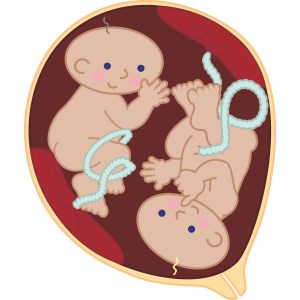
I got to thinking about the first combination Twin delivery I had witnessed back in the very early 80’s. This was actually one of our own (hospital employee) nurses .  She was a multip…. around 37-38 weeks and healthy…no complications during pregnancy. Twin A delivered spontaneously, vaginally with a generous episiotomy as they often performed at that time… The baby , a girl, was about 6 pounds, vigorous and had no problems. We were all marveling at the first baby, checked fetal hearts on the second twin and started waiting for him to get in position.  Still before consistent ultrasound, we were not worried. However, we had a newer doctor who was attending this birth. He began to get concerned after 5- 10 min when contractions slowed and he was worried that if this baby was breech, he would have difficulty with the “after-coming” head. Up to this point, all I had learned was this can be a real concern if the smaller feet or buttocks present through a cervix which is not fully dilated. Much research was done later on but at the time, I did not know about it. He began to ask us to call the OR for a C/S. This was unheard of in my limited experience at the time…. my 70’s world. I thought.. how can they do a C/S now when one baby was already born??? I tried to be an advocate… (my early days… )”We have Piper forceps…”  I said meekly… “Have you tried to grab a large part and help bring the baby down… ?” This was my limited knowledge… all I knew to suggest. I kept wishing one of the other doctors was on duty that day.. or maybe we could call them???

In front of the mother, he said to me “I’m not going to have a bad outcome here!” By now it was 20 minutes or so. There was no cord prolapse, no drop in fetal hearts, no evidence of immediate trouble… the baby was seeming to work itself into breech position…. To the mother he said “Your baby is in serious danger and the best thing to save him is to take you for a Cesarean now!” “I’ll sew your episiotomy together while we are in the OR.”

I was in shock. She signed, scared to death of course. So we prepped her for the OR. She went up for a C/S of her second twin and repair of her generous episiotomy. Her second baby was delivered frank breech…  a beautiful boy about the same size and was also vigorous and healthy. I remember I felt as though she was almost assaulted. I remember feeling that this was a true rare event if it every happened before. There was no immediate access to information like today.

Luckily mom and babies did fairly well in the postpartum period even though healing from both the episiotomy and the C/S was difficult for her.

"How can I get out if I'm not head 1st ??"

" Psst-- How can I get out if I'm not head 1st ??"

I wanted to see how much research I could find on this topic. I had gone to the green journal (OB & GYN) website but then it locked me out. (You can only look at abstracts anyway unless you want to purchase the article. You are on your own for that.) I had some luck with the abstracts at PubMed so I have put a few here.

I decided to take a look across time…….

This first one is from 1981. . Quoted abstract from the PubMed site:

Cesarean Section for Delivery of the Second Twin

Evrard,JohnR.; Gold, Edwin M.
Obstetrics & Gynecology. 57(5):581-583, May 1981.

Four cases of combined vaginal-abdominal delivery of twins are presented, and an additional 5 cases from the recent literature are discussed. Malposition, malpresentation, and contracted cervix were the main indications for cesarean section for the birth of twin B. In the 9 cases presented, there were 2 perinatal deaths.

Interesting that this research was done during the same time frame as my experience above. I’d like to know more about those poor outcomes 😦

The next interesting article I found was researched over a 10 yr period, somewhat close to here in a larger facility, published 1997. THIS study examines the delivery of the second twin by utilizing external version vs breech extraction . 😉 The results are showing in favor of breech delivery vs version (those meeting exclusionary criteria ).. Versions were associated with higher a incidence of Cesarean and fetal distress. Neonatal outcomes no different and are stated below:

Method of delivery of the nonvertex second twin: a community hospital experience.

 Smith SJ, Zebrowitz J, Latta RA.   J Matern Fetal Med. 1997 May-Jun;6(3):146-50

Abington Memorial Hospital, Pennsylvania, USA.

The purpose of this study is to examine the incidence of cesarean section and fetal distress complicating the delivery of the second twin in vertex-nonvertex twin gestations in which the second twin underwent either breech extraction or external version. The intrapartum courses of 510 twin gestations delivered at a community hospital over a 10-year period were retrospectively analyzed. All vertex-nonvertex twin gestations were identified in which the second twin underwent attempted breech extraction or external version. Exclusion criteria included birthweight < or = 1,500 g, fetal anomaly, intrauterine demise, and monoamniotic twins. Of the 76 twin sets that met inclusion criteria, 33 underwent external version and 43 underwent primary breech extraction. The two groups had similar demographic characteristics. External version compared to breech extraction was associated with a significantly greater incidence of cesarean section (8/33 vs. 1/43, P = .008) and fetal distress (8/33 vs. 1/43, P = .008). There was no difference between groups in neonatal outcome for the second twin as measured by length of stay, 5-minute Apgar < 7, intensive care unit admissions, hyaline membrane disease, intraventricular hemorrhage, and traumatic birth injury. In conclusion, the increased incidence of cesarean section and fetal distress in patients undergoing attempted external version suggests that breech extraction may be the preferable route of delivery for the nonvertex second twin weighing more than 1,500 g

The next study was published a little later in 2001 and covered a 20 year span of time… during the 80’s and 90’s at a larger center in Nova Scotia, Canada. They noted an increase in their combination vaginal/cesarean twin births and documented some statistical data, looked at reasons for an operative second twin birth. I wish to read this study further some day to see if there is mention pertaining to mother/baby outcomes other than statistics outlined (even though that wasn’t their objective) in this abstract:

Combined Vaginal-Cesarean Delivery of Twin Pregnancies

Obstetrics & Gynecology . 98(6):1032-1037, December 2001.

Department of Obstetrics and Gynaecology, Dalhousie University, Halifax, Nova Scotia, Canada.

OBJECTIVE: To estimate the incidence and factors associated with combined vaginal-cesarean delivery in twin pregnancies. METHODS: We studied all twin births weighing 500 g or more during a 20-year period (1980-1999) at a tertiary care center. Major anomalies, monoamniotic and conjoined twins, and antepartum fetal deaths were excluded.

RESULTS: During this 20-year period, 105,987 women delivered, of whom 1565 (1.5%) had twins. Of these, 1151 twin sets fulfilled the study criteria. The mode of delivery was vaginal in 653 (56.8%), cesarean in 448 (38.9%), and vaginal-cesarean in 50 (4.3%). During the 20 years there was a statistically significant increase in combined vaginal-cesarean and elective cesarean deliveries, with a decrease in vaginal deliveries. Parity, gestational age, and birth weight discordance (>25%) were not associated with combined delivery. Compared with vaginal delivery, the nonvertex second twin was associated with a twofold higher risk of cesarean delivery (relative risk [RR] 2.3; 95% confidence interval [CI] 1.3, 3.8; P =.002); and an interdelivery interval of over 60 minutes with an eightfold higher risk (RR 8.2; CI 4.6,14.6; P <.001). Vaginal-cesarean delivery had a 22-fold higher use of general anesthesia compared with vaginal delivery (RR 21.8; CI 5.4, 88.5; P <.001). CONCLUSION: There has been a significant increase in combined vaginal-cesarean and elective cesarean deliveries among twin gestations, with a decrease in vaginal births. Vaginal-cesarean delivery is associated with nonvertex second twin and a prolonged interdelivery interval.

Now we come to 2008!  There is a study here from Texas. This study looked a twins born by C/S after labor and twins who had cesarean birth of the second twin. they campared outcomes to see if the twin of a combined delivery had more problems. The most important pieces of information I gather from this abstract of results…. (again, having NOT read the entire study):

“Combined twin delivery may be associated with endometritis and neonatal sepsis when compared with a twin delivery where both are delivered by cesarean in twin pregnancies experiencing labor. More serious neonatal sequelae, including hypoxic ischemic encephalopathy and death, were not affected by the route of delivery of the second twin.”  Hmmm 

Cesarean Delivery for the Second Twin

Alexander, James M.; Leveno, Kenneth J.; ….et al:for the Eunice Kennedy Shriver National Institute of Child Health and Human Development (NICHD) Maternal-Fetal Medicine Units Network (MFMU)   Obstetrics & Gynecology . 112(4):748-752, October 2008.

Department of Obstetrics and Gynecology, University of Texas Southwestern Medical Center at Dallas, 5323 Harry Hines Boulevard, Dallas, TX 75235-9032, USA. james.alexander@utsouthwestern.edu

OBJECTIVE: To examine maternal and infant outcomes after a vaginal delivery of twin A and a cesarean delivery of twin B, and to identify whether the second twin experienced increased short-term morbidity as part of a combined route of delivery. METHODS: Between January 1, 1999, and December 31, 2000, a prospective cohort study of all cesarean deliveries was conducted at 13 university centers. This secondary analysis was limited to women with twin gestations who experienced labor and underwent cesarean delivery. We compared outcomes of the second twin in women who had vaginal delivery of the first twin and a cesarean delivery of the second twin to those who had cesarean delivery of both twins. RESULTS: One thousand twenty-eight twin pregnancies experienced labor and underwent cesarean delivery; 179 (17%) had a combined vaginal/cesarean delivery. Gestational age at delivery was 34.6 weeks in both groups (P=.97). The rupture of membranes to delivery interval was longer in the combined group (3.2 compared with 2.3 hours, P<.001). Endometritis and culture-proven sepsis in the second twin were more common in the combined group, respectively (n=24, odds ratio 1.6, 95% confidence interval, 1.0-2.7; n=15, odds ratio 1.8, 95% confidence interval, 1.0-3.4). These differences were not significant after logistic regression analysis. There were no statistically significant differences in an arterial cord pH of less than 7.0, Apgar score less than or equal to 3 at 5 minutes, seizures, grade III or IV intraventricular hemorrhage, hypoxic ischemic encephalopathy, or neonatal death. CONCLUSION: Combined twin delivery may be associated with endometritis and neonatal sepsis when compared with a twin delivery where both are delivered by cesarean in twin pregnancies experiencing labor. More serious neonatal sequelae, including hypoxic ischemic encephalopathy and death, were not affected by the route of delivery of the second twin.

I gather from these studies that a combined delivery route leads to more problems.. however…there are probably more problems than breech presentation alone to lead the provider to make that choice. I believe that many newer providers of obstetrics in a hospital setting are more apt to do a scheduled C/S for any vertex-nonvertex twins they encounter. That is what is done in my facility today. The same for all breech presentation singleton gestation.

Where is that old-fashioned nurse when you need her?? How ’bout the old fashoined doc??? 😉

I am very interested in anyone’s story or experience either in healthcare or your personal birth. Please let me know if you know anything about this!

Thanks for reading!

Watch Wednesday ~ WAIT to Clamp Cord!

Watch the video Wednesday

Just read an awesome Post about Delayed Cord Clamping by a fellow Labor and Delivery Nurse who has an excellent blog you should all read. I have a link to it on the right hand side… “nursingbirth”.

She did tremendous research and has supplied fabulous information. 

Here’s a shout out to you nursingbirth!!

Watch this video..