Skip to content

Posts tagged ‘delivery’

A Formula Rep turned my Maternity Leave Injury into a new career as an IBCLC? Really?

matleavecarnivalbox

My contribution to this fabulous Carnival of Maternity Leave  , is a story of how during my maternity leave, an injury occurred leading to a career change specializing in Lactation… ! It starts with the birth of my third and last baby…… A  girl….. (after 2 boys) was also born by C-Section.. a first for me.

Well– first, let  me back up a few years… I’ve had a potpourri of maternity leaves. I have been a Maternity/L&D/Nursery since the mid 70’s.  I always worked full time and had never entertained thoughts of staying home with my children once they were born because the USA didn’t assist in providing any type of viable option for families who rely on two incomes or single moms with one income.  Prior to FMLA,  maternity leave was pretty much up to the employer as far as I understand it. The USA doesn’t offer any paid leave (unless offered by individual employer). For my first baby in 1979- I took 7 .5 weeks and went to a weekend 12 hr shift job which at least allowed me 5 days each week with him. 

 When my next baby was born in 1985, I worked at the same facility I am now. We were allowed to save up ALL Vacation, Holiday, and Sick time to be used collectively with your hospital allowed 12 weeks off.  I was able to have 5 1/2 months total, partially paid time to be with my new baby. Since he had to have surgery at 3 months, I needed that time and could have used more.. My leave was actually supposed to end on Christmas day (YUK).. however, they graciously allowed me to come back on the 26th… also his first day in Day Care. 😦

So back to my third baby in 1988~I had had a C/S — (that’s another story).  I had to be hospitalized for 10 days after the surgery with a whopping infection. A fresh incision and chills with a temp of 103.8 do not go well together! [Nurse Curse] Anyway, I made it thru–> healed and returned to life as a mother of three. The same type of collective accumulated paid hours were allowed withthe hospital’s offered 12 weeks. I didn’t have as many hours saved up as last time but was hoping for the best length of time.  One day in church, I held my little 2 month old baby girl on my shoulder with one hand, while using the other to hold the hand of my active 3 yr old boy as we made our way down the aisle. Suddenly, my boy squealed with delight and whipped over in a different direction. I held my daughter and did a sudden twist and reach for my son as he squirmed away. I immediately felt something “give” in my back.

It took a few days for me to feel the true extent of the injury. I thought it was just a little pulled muscle. After a 5 hour drive to my sister’s for a family visit, I ended up writhing on the floor with the unstoppable intractable “fire hot poker” pain of full blown sciatica…. all down my right side. I had to go to the hospital ER away from home, unfamiliar doctors, for help and drugs! Boy, I needed relief. As explained to me by the doctors… this was not the same as sciatica from many other causes. This was a swollen inflamed sciatic nerve… we didn’t know why yet.  The only thing helping at that point was medication and ice.. a lot of ice. I still insisted they give me meds I could take while breastfeeding, so they weren’t too strong.

I got home, went thru an MRI and diagnostic process, different doc’s, different opinions. I had a disc “blow-out” with”free extruded disc fragments” at L5-S1. Some felt surgery was needed immediately, others said to wait.  After careful consideration, we decided to wait and do some conservative type treatments with oral and epidural steroids. I still had to heal well enough to work, though. I spent many nights crying and wondering HOW I could work ??? How could I go and be on duty…running all over to keep up with the pace, helping people thrulabor and delivery…respond to emergencies…how?? I could barely care for my family! I called many friends while I was on periods of bed-rest and had various treatments during the time I had left of maternity leave. (I eventually did have to extend the leave a couple weeks for more recovery. I ended up witha 5 month leave altogether). I was searching for ideas.. visions of something less physically taxing which could combine my knowledge of labor/delivery/postpartum and neonatal care….. and allow me to continue working. I was, after all, the major bread-winner in our family!

Finally, a friend came up with an idea. He was actually a formula and drug rep for Ross labs.. TRUE!! But he was a friend, had heard I was hurt and stopped by the house to see how I was. He was a rep to many hospitals in the NorthEast and had exposure to what else was going on– what other hospitals were doing.  This was 1988, only a few years after the emergence of the Lactation Consultant profession. I had never heard of it. Sometimes word traveled slowly (by pony express) and things changed slowly in my little neck of the woods. He encouraged me to check it out and gave me phone numbers of LC’s at some of his other hospitals. I was really excited! I called a few and found out more about the lactation profession and the relatively new Board exam given every year in July to gain the credential of IBCLC.  I was actually naiveenough to think I could take the exam with my current knowledge base!  HA! (Unfortunately, this is what many nurses with a little experience think…we think we already know it all! Ha!) 

I called one of the LC’s at a hospital not too far from me. We talked a while and I had my eyes opened as to the extensive and vast knowledge base needed to become a lactation professional. I launched a quest for the best way to gain this knowledge. I joined LLL and went to meetings. I made home visits with the local LLL leader. I wrote many letters, made many phone calls searching for some type of education program. (remember– no Internet back then!)

Finally I found the perfect program for me. There was a correspondence course offered to be done all through the mail and phone calls designed to be an 18 month course.  It was a Lactation Consultant Course offered by BSC Breastfeeding Support Consultants! (the link shown is for their current course) Back then, you could be called a Certified Lactation Consultant after completing the clinical practicum and final exam. Because of continued back problems, I started this course in early 1989, had to take a few months leave from the course and completed it in early 1991. I then went on to continue studying and sat for the IBLCE exam in 1993 earning  my IBCLC status!

I have always continued to work as a staff nurse. I found a corset style back brace and found the best balance possible between family, back pain, work and more pain. I was able to get the pain subdued with steroids to carry on with life. In 1992, during a particularly gruesome relapse, I eventually consented to a myleogram… something I had previously NOT wanted. They also did a CT scan while the dye was in place. These tests showed my right Sciatic nerve had been pushed way up out of place by the disc material. I consented to surgery by a fabulous neurosurgeon the very next day. It turns out, the disc was actually adhered to my sciatic nerve!! He had to meticulously excise it off the nerve!!  My post-op pain was minimal compared to the pain I had before surgery. I was able to go back to full duty in 8 weeks!

Over 20 years later, I am still working as a staff nurse and am now a CLC… Certified Lactation Counselor.  Becoming a breastfeeding professional has enhanced and fortified my life! I am immensely happy I have gone down this road. To think it all came about as a suggestion from a Formula Rep!?!?!

Hope all had a great WBW 2009!!

Hope all had a great WBW 2009!!

HomeBirth Transfer~ Doc says NO to C/S~

I wrote a few stories a few weeks ago because I was proud of my hospital that week– sorry I didn’t finish the stories until now……

iStock_000004564778Small

~She lived about 8 -10 miles outside of town. “Ellie” was having her first baby at age 32.  First baby, first pregnancy, no risk factors…. an easy uncomplicated pregnancy. She had done some research, not extensively, judging from some of my conversations with her and her husband…but she knew what she wanted. She had made a beautiful plan with a CPM for a water tub home birth. This particular midwife has been doing home-births in my area for a long time.. (She was the one cowering in the L&D hallway in this story…). The story of how things progressed up to transfer to the hospital was told to us by both the mother, father and midwife. 

~Her labor started with regular contractions at 39 weeks. They progressed from early labor which lasted around 6 hours to a more active labor with contractions about every 2- 3 minutes.  Her cervix had dilated to 6-7 cm. This pattern of contractions continued for hours. Ellie was in and out of the tub, walking, dozing, in and out of the shower, squatting, doing many different position changes throughout the next 6 to 8 hours. When she was re-examined by her midwife, she had made no cervical change in all that time. This can happen sometimes, things can stall out and pick back up again. Ellie reported that the contractions may not have been as strong at that, so she wanted to wait it out, maybe nap. The baby’s heart rate checks were all good.

~Everyone rested about 2 hours … Ellie’s water broke (clear fluid)  about 1 am and her contractions got more intense. The CPM checked her cervix about 3 am and felt no change. She still was 6 -7 cm dilated and the head was at about -2 station. The midwife then brought up the idea of possibly transferring to the hospital. Ellie said NO! Is my baby alright? “Yes….” said her midwife.. “Then No..I’m staying here, — I can do this.”

~Back to the tub… In and out of the shower, total body massages.. contraction pattern the same with increased intensity…next cervix check at 730 am… still 6-7 cm. Now Ellie was tired. Really tired. Exhausted! The baby was great on all checks. Her midwife again brought up the transfer to hospital idea, talked to her about the possibilities of pitocin, epidural etc… Ellie was now wanting anything, agreeing with anything–to get this over with.

~She arrived at the hospital around 8- 830 am very upset. Her husband and midwife were with her and her CPM had all her prenatal care info. Some of the first words out of Ellie’s mouth were that she wanted an epidural and a Cesarean! The nurses on duty this morning were awesome! They calmed her down, had her hooked up to the fetal monitor and observed her contraction pattern and the fetal heart rate pattern response. The baby looked excellent! The midwife and hubby coached her through the contractions while the nurses gathered their admission data.  The doctor checked her and she was still about 6-7,  swelling of the cervix noted, about -1 station. Ellie asked him if he would please do a C/S and he said no… (yeah!).  He said that he felt the best option at this time was to do the epidural she was asking for and observe her contraction pattern… possibly add Pitocin. He talked to her so nicely and non-judgmentally. Many of the other docs would have taken her right into the OR with very little discussion of options. She had been 6-7 cm dilated for some approximate 16 hours.

~After the epidural, Ellie and her husband and midwife all slept. The doc did NOT start pitocin right away, he said that she may need to rest and the contraction pattern couldstart to become of better quality once she rested and was better relaxed. WOW! Where did this guy come from? I’m so amazed and happy and quite frankly, shocked. This was a newer OB here.. I wanted to ask him where he’d been all my life! I went in to talk to Ellie and introduced myself. I told her I was so sorry thingsweren’t progressing the way she had hoped and sorry she didn’t get to stay home. She thanked me and said at this point, she was ready for it to be over! I told her she was really quite fortunate to have this particular doctor on duty today. Except for one bad apple from the night shift just leaving when Ellie arrived, everyone was wonderfully supportive and accommodating. Ellie’s contractions indeed did start up in a better intensity pattern on their own….. however their continued to be a lack of progress.  Once again, she asked the doctor to get it over with now and please do a C/S. 

~The doctor said NO again! He explained that her uterus was probably tired and the quality/intensity of contractions just may not be what was needed for the job to get done. He explained that the fetal heart rate tracing was beautiful and her membranes had been ruptured less than 12 hours. No baby risks…  He felt it possible the baby merely needed to get in better position and the contraction quality needed to improve.. and then he would re-evaluate. Ellie agreed with renewed optimism. The pitocin drip was started. She didn’t need much before the contraction pattern got much stronger, longer and better quality.  He came to re-evaluate her only after these better contractions had been consistent for 2 hours. The vaginal exam revealed the cervix was the same ..still the same and possibly more swollen.  He said he felt the head was not as well applied to the cervix as it had been.. but still at -1 station. He examined her with and without a contraction. Same in his opinion. Ellie lost all her fight. Her support people rallied to help her, but she was now insistent.

~This time the doctor  said she certainly had reason to feel this way, had given this a great try. He told her he still felt she could try longer… that we could alter positions with the pitocin, keep her comfortable with the epidural and keep going… the baby was handling all this just fine. He did say that there was a possibility the baby had his head in a tilted position making it difficult to descend the birth canal. He then let it up to her and told her if she wanted the C/S, he would do it at this point.

~YES I want a C/S! Ellie exclaimed. We did the C/S about 3 pm… some 7 hours after transfer and approximatelyclose to 24 hours of being 6-7cm dilated. Her gorgeous 7 lb baby boy was delivered operatively with apgar scores of 9 and 9. Pink and vigorous! Beautiful. I was able to get him skin to skin in the OR.. that was one of the first times all the players didn’t object and I went with it! (It won’t be the last….and next I’m trying for breastfeeding on the OR table!) Upon delivery, the OB noted the baby had been acynclitic . This is when the head is tilted to the side, ear towards the shoulder.  It is probably responsible for her long stall in labor. The OB still felt she could have delivered vaginally given time and good management. I am just so happy he was there.  I am proud of this mom, her partner and midwife and of our whole team! This mom was able to make good educated choices about her care despite dealing with the stress of a transfer.. and was able to feel so very very proud of how hard she tried.

In the end it was her…… who gave in to the C/S … not her doctor. 

Of that we can be proud

🙂

I’m Proud of my Hospital….~ this week ~

~I’ve reason to be a little proud of the care given this week.008

I hope this is a continuing trend of attention to detail, utilizing evidence-based practices and compassion, listening to our patients and providing them with options and the best possible care…. I’ll give you a few details about each as you read on… In summary, this week we have had the following situations:

  • A 25 week-er walk-in with a precipitous delivery stabilized & tranported quickly
  • Twins! Vertex/vertex –turned breech– turned vertex~ delivered vaginally
  • A Heroin/Cocaine  addict identified, baby able to be treated appropriately so comfortable transition
  • Safe Haven newborn about 1 day old.. placed up for adoption
  •  Homebirth Transfer handled with great respect overall and most importantly, the mother is happy with her experience.

Whew! We have a lot of busy weeks but they don’t always have this intensity or variety! I feel proud because there may have been a few things done differently due to recent conversations I’ve had…Plugs I’ve made… and I keeping putting in little plugs to try to gently increase awareness & educate. I am an Instructor in Neonatal Resuscitation and Lactation.. sometimes the troops listen when I talk about other topics…. I’m no expert but I try to be current, correct and compassionate in care. (My 4 c’s)

Okay… the details for the first 3… stay tuned for the others…..

~25 Week gestation walk-in~

She came in with mild cramps and pressure. She didn’t report any fluid leakage but did C/O pink vaginal mucus. We had her in an exam room pronto. She had a gentle speculum exam which revealed hour glassing membranes thru an approximate 4-5 cm cervix..visually.  Hour-glassing means that the intact amniotic sac has protruded thru the partially dilated cervix and expanded like a bubble  in the vagina. She went right into trendelenburg. The transfer teams were called. It was soon clear she would deliver here and the baby would need to be stabilized and transferred. The NICU team contacted us back they would be flying up to retrieve. The nurses caring for her were tremendously supportive.  All procedures explained, options offered and decisions honored.  They got her records faxed over from her OB’s office so we had a little history.

Like a well oiled machine (from all of our drills), all the emergency equipment was readied, pediatrician in attendance, roles clarified. Once he was born almost without warning, precipitously, all at once, about 30 minutes later. He was quickly assessed, wrapped in plastic, ventilated, then intubated. We had a peripheral IV in place in case he needed meds or fluid volume. He had a chest xray and a blood culture/blood count sent.  He was kept warm, ventilated and appropriately oxygenated and had stable glucoses. He weighed in at about 700 gms (about 1 1/2 lbs). The team arrived when he was about 30 minutes old. They checked all labs, xrays and his IV line. They gave him Surfactant and pretty quickly and carefully,  loaded him in the transport incubator then got him out to his mommy for a visit before he was transferred. They answered all her questions before they left and we helped her deal with it all. The doctors discharged her shortly after that so she could get down to her baby.  At last report, he was doing just as expected for 25 wks, no other complications often seen at that gestation, for ELBW (Extremely Low BirthWeight) had come up. He was actually improving each day! So happy for everyone!

~Twins!~

She came in to the hospital already in very active labor at 37.5 weeks gestation. Her twins were both head down (vertex/vertex). She labored quickly, uneventfully and delivered Twin A at about 1 pm. With the ultrasound machine in the room, they scanned over her still pregnant belly to see where Twin B was and if he was still in position. Turns out that once Twin A had vacated the womb, baby B had a lot of room and he had moved into a transverse/breech position. That means he was more bottom first than head first anymore. Most Ob’s now don’t attempt a breech delivery even with the second twin.  They are quick to do a C/S…. This day, however, …. the Ob in charge called over an associate to ask his opinion. They brought the mom into the OR and prepared to do a C/S  if they were unable to get the baby in proper position. The point is they were at least going to TRY!  With the U/S scanner and 2 assistants, they did an external version and worked Twin B  back into a head down vertex position without complication. He delivered vaginally about 1 hour and 45 minutes after his brother! The staff kept the first twin in the room the whole time so they could all be together. I spoke to the Ob later and congratulated him on a great job.. he said to me that he remembered what we had talked about awhile ago (when I had written the post about a C/S for the 2nd twin), and had researched it himself. I was happy that any little plug I had made had sparked interest in researching the topic and possibly even influencing a decision towards better care! I am happy to report that both babies went home with mommy on day 2!

~A Heroin/Cocaine addict~
We are attempting to put together some consistant protocols for drug screening so that we don’t miss the opportunities to protect a newborn in need…. Some may not understand how important it is to sometimes screen the healthy and innocent to weed out those with problems…. They don’t always present in an obvious way. From my perspective, those individuals who are hiding something are very difficult to identify from outward appearance only. We identified a heroin/cocaine addict recently who was a very beautiful, well groomed, well nourished, affluent (seemed wealthy) woman who stated she was just visiting in our area, and had no prenatal care info or records with her…. she was in rip-roaring very active labor at 36 1/2 weeks with heavy vaginal bleeding and fetal distress. We thought we were headed to the OR but the baby had other ideas. We had little time to get more information before the baby was born. There was a small abruption but luckily, the baby was vigorous and did not seem to have suffered blood loss. The admitting nurse had collected a urine sample with a catheter insertion and sent it for drug screen. It came back positive for Opiates, Cocaine and THC. The baby’s urine also tested postive for Opiates, Cocaine and THC. Because we knew, we were able to start the NAS (Neonatal Abstinence Scoring) for signs of drug withdrawal and identify the signs quickly. If the baby is unable to be comforted by swaddling or holding or if we had 3 scores of 8 or higher, there are protocols set up for medicating the baby. The baby did require medication within 24 hrs. Once medicated, she was such a happy sweet little girl. The nurses named her “Molly” and we all loved her. She stayed with us all week until the pediatrician released her andChildren’s Services placed her in a foster home experienced with this kind of care. Unfortunately, some of the big drug problems have hit my area. Our local paper just did a big series of stories on local Heroin addiction problems. Apparently it is cheap and accessible.

I am going to publish this part tonite and tell the other two stories soon…

No Prenatal Care? …..What are YOU Hiding??

No Prenatal Care is usually a symptom of something--hiding some type of underlying problem. Sometimes it's very ugly. The most common encounters we have involve illicit drug use during pregnancy. We need to develop a comprehensive Maternal and Neonatal Drug Screening protocol to protect the newborn.

Read more

OB Docs and Nurses Scoff at Homebirth

My community hospital’s views have never been in favor of any type of home-birth… whether it’s with a skilled professional  practitioner or a skilled lay midwife. There could have been some free unassisted births going on but we were not aware….  As I grew-up in this profession, I learned first from my experienced counterparts…then I began to educate myself and learned a lot from mothers and babies.  The doctors and nurses I worked with were all stagnant in their knowledge in my early years. They were satisfied with how things were.  I was young, I had an open-minded philosophy and an eager quest for knowledge.

In the later 70’s, just when we began to have mothers speak out and request a more natural childbirth, I had a few friends who enlisted the aid of some lay midwife in the region and arranged for homebirths. They all had a really nice birth experience without a single complication. Perhaps that was why I was open to the idea even though I was not personally involved. Besides some of the truly prepared couples who came in and had incredibly beautiful births….. that had been my first exposure as an alternative option to the knock’em out–pull’em out births I had been working with on the job. I knew my friends were very low-risk and had done their homework. 

   However, the hospital’s exposure to a homebirth in those days was only if the homebirth went awry for some reason or another and they came in our doors seeking help…  here’s what the docs and nurses would say to one another :

  • “Can you believe she planned to deliver at home???”
  • “How could she take take a chance like that with her baby?”
  • “The reason people started coming to hospitals to give birth was because mothers and babies were dieing at home….she must be crazy or totally insane!!”

   We’ve had planned homebirths come in for various reasons, as I am sure other facilities did…. (keep in mind that in my area, the usual birth attendant was a lay midwife). The situations bringing the mother to the hospital were often scary and upsetting for her. The most common were:

  • Fetal heart rate decels with or without meconium stained fluid 
  • Lack of progress with pushing mostly after many hours..
  • Higher than normal bloody show or bleeding–possibly abrupting
  • Breech, brow or face presentation
  • Retained placenta

Often the OB’s didn’t handle themselves well.. certainly not professionally. We had this one OB who would call for the OR to be opened before he even examined the patient or evaluated the situation…..regardless of why they came in.  And he often actually yelled at the mother, in the middle of her scary situation.

“Your baby will die if we don’t do an emergency C/S right now, why did you let this happen!”

Most often the backlash was directed at the midwife who cowered in the hallway- uninvited by the staff, left alone detached from her patient. She never left the unit though until she was afforded the opportunity to visit and speak to her patient. 

The two significant situations I remember which would fall in to statistical data for morbidity were:

  1.  An abruption which resulted in a crash C/S upon admission and a neonatal resuscitation with good response….(final apgars 3@one min then 7@ five min) positive overall outcome, no long term sequelae.
  2. A birth where the father (a chiropractor) was the birth attendant for his wife, a multip, encountered a shoulder dystocia and the baby ended up with a displaced fractured left humerus. That baby was in a crib with traction to realign the bone. The child went on to be an honor student at a local university after homeschool.

I feel that instead of the midwife or mother receiving hostility (or even the mother being wisked away to the OR without a trial of something if the baby was deemed stable..)~ the staff should have behaved in a compassionate professional manner, acting on any urgent situation with consideration that this mother is now experiencing not only labor but fear and grief over the loss of her beautiful planned birth.

Despite all the negativity from the staff, we never had a seriously bad outcome from attempted homebirths arriving on our doorstep.  We still have attitude problems, probably always will~ just as we do with breastfeeding.  I wish they could  look at it from my perspective. Those who choose homebirth today have better information to hopefully make an educated informed decision about their birth options and choose wisely. I really like Ricki Lake’s “The Business of being Born” among other’s. I hope those choosing homebirth are truly investigating all these options, deciding what is best for them and not making any decisions out of “anger at the system” or any sort of revolutionary zeal.  

  There is so much out there for medical professionals to be aware of other than what goes on in their tiny little realm, their little part of the world. My co-workers and doctors need to be better informed.  

Any one bad outcome (which most certainly happens in the hospital)  does not mean that every homebirth is a bad idea.

Wednesday’s Watch~ Children and Birth

Do American Children know this much about birth?

dematronas  …. de matronas… 

This YouTube video is a very well done example of the beauty of birth and the beautiful innocence of children.

These children are interviewed about birth and midwifes and babies.
They are very very smart indeed!
I found this courtesy of my new twitter friend @ketchup74.

From Spain or Argentina? with English subtitles.


Has anyone seen or found a video as beautiful or remarkable as this? Please send me a link if you have!

Check the comment for some great links already! Thank you!

Cesarean Delivery of the Second Twin… Why? 

029I was talking to one of my on-line Twitter friends @onefinebreeder about twin delivery. I was telling her about how things used to be.. how vertex-nonvertex twin gestation’s were always delivered vaginally ….. and she commented on how it was sad that some of the old OB skills have been totally lost to surgery… So Very True!
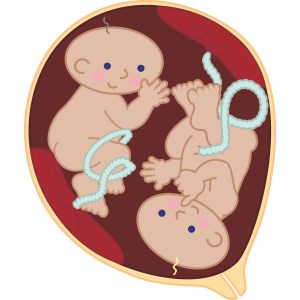
I got to thinking about the first combination Twin delivery I had witnessed back in the very early 80’s. This was actually one of our own (hospital employee) nurses .  She was a multip…. around 37-38 weeks and healthy…no complications during pregnancy. Twin A delivered spontaneously, vaginally with a generous episiotomy as they often performed at that time… The baby , a girl, was about 6 pounds, vigorous and had no problems. We were all marveling at the first baby, checked fetal hearts on the second twin and started waiting for him to get in position.  Still before consistent ultrasound, we were not worried. However, we had a newer doctor who was attending this birth. He began to get concerned after 5- 10 min when contractions slowed and he was worried that if this baby was breech, he would have difficulty with the “after-coming” head. Up to this point, all I had learned was this can be a real concern if the smaller feet or buttocks present through a cervix which is not fully dilated. Much research was done later on but at the time, I did not know about it. He began to ask us to call the OR for a C/S. This was unheard of in my limited experience at the time…. my 70’s world. I thought.. how can they do a C/S now when one baby was already born??? I tried to be an advocate… (my early days… )”We have Piper forceps…”  I said meekly… “Have you tried to grab a large part and help bring the baby down… ?” This was my limited knowledge… all I knew to suggest. I kept wishing one of the other doctors was on duty that day.. or maybe we could call them???

In front of the mother, he said to me “I’m not going to have a bad outcome here!” By now it was 20 minutes or so. There was no cord prolapse, no drop in fetal hearts, no evidence of immediate trouble… the baby was seeming to work itself into breech position…. To the mother he said “Your baby is in serious danger and the best thing to save him is to take you for a Cesarean now!” “I’ll sew your episiotomy together while we are in the OR.”

I was in shock. She signed, scared to death of course. So we prepped her for the OR. She went up for a C/S of her second twin and repair of her generous episiotomy. Her second baby was delivered frank breech…  a beautiful boy about the same size and was also vigorous and healthy. I remember I felt as though she was almost assaulted. I remember feeling that this was a true rare event if it every happened before. There was no immediate access to information like today.

Luckily mom and babies did fairly well in the postpartum period even though healing from both the episiotomy and the C/S was difficult for her.

"How can I get out if I'm not head 1st ??"

" Psst-- How can I get out if I'm not head 1st ??"

I wanted to see how much research I could find on this topic. I had gone to the green journal (OB & GYN) website but then it locked me out. (You can only look at abstracts anyway unless you want to purchase the article. You are on your own for that.) I had some luck with the abstracts at PubMed so I have put a few here.

I decided to take a look across time…….

This first one is from 1981. . Quoted abstract from the PubMed site:

Cesarean Section for Delivery of the Second Twin

Evrard,JohnR.; Gold, Edwin M.
Obstetrics & Gynecology. 57(5):581-583, May 1981.

Four cases of combined vaginal-abdominal delivery of twins are presented, and an additional 5 cases from the recent literature are discussed. Malposition, malpresentation, and contracted cervix were the main indications for cesarean section for the birth of twin B. In the 9 cases presented, there were 2 perinatal deaths.

Interesting that this research was done during the same time frame as my experience above. I’d like to know more about those poor outcomes 😦

The next interesting article I found was researched over a 10 yr period, somewhat close to here in a larger facility, published 1997. THIS study examines the delivery of the second twin by utilizing external version vs breech extraction . 😉 The results are showing in favor of breech delivery vs version (those meeting exclusionary criteria ).. Versions were associated with higher a incidence of Cesarean and fetal distress. Neonatal outcomes no different and are stated below:

Method of delivery of the nonvertex second twin: a community hospital experience.

 Smith SJ, Zebrowitz J, Latta RA.   J Matern Fetal Med. 1997 May-Jun;6(3):146-50

Abington Memorial Hospital, Pennsylvania, USA.

The purpose of this study is to examine the incidence of cesarean section and fetal distress complicating the delivery of the second twin in vertex-nonvertex twin gestations in which the second twin underwent either breech extraction or external version. The intrapartum courses of 510 twin gestations delivered at a community hospital over a 10-year period were retrospectively analyzed. All vertex-nonvertex twin gestations were identified in which the second twin underwent attempted breech extraction or external version. Exclusion criteria included birthweight < or = 1,500 g, fetal anomaly, intrauterine demise, and monoamniotic twins. Of the 76 twin sets that met inclusion criteria, 33 underwent external version and 43 underwent primary breech extraction. The two groups had similar demographic characteristics. External version compared to breech extraction was associated with a significantly greater incidence of cesarean section (8/33 vs. 1/43, P = .008) and fetal distress (8/33 vs. 1/43, P = .008). There was no difference between groups in neonatal outcome for the second twin as measured by length of stay, 5-minute Apgar < 7, intensive care unit admissions, hyaline membrane disease, intraventricular hemorrhage, and traumatic birth injury. In conclusion, the increased incidence of cesarean section and fetal distress in patients undergoing attempted external version suggests that breech extraction may be the preferable route of delivery for the nonvertex second twin weighing more than 1,500 g

The next study was published a little later in 2001 and covered a 20 year span of time… during the 80’s and 90’s at a larger center in Nova Scotia, Canada. They noted an increase in their combination vaginal/cesarean twin births and documented some statistical data, looked at reasons for an operative second twin birth. I wish to read this study further some day to see if there is mention pertaining to mother/baby outcomes other than statistics outlined (even though that wasn’t their objective) in this abstract:

Combined Vaginal-Cesarean Delivery of Twin Pregnancies

Obstetrics & Gynecology . 98(6):1032-1037, December 2001.

Department of Obstetrics and Gynaecology, Dalhousie University, Halifax, Nova Scotia, Canada.

OBJECTIVE: To estimate the incidence and factors associated with combined vaginal-cesarean delivery in twin pregnancies. METHODS: We studied all twin births weighing 500 g or more during a 20-year period (1980-1999) at a tertiary care center. Major anomalies, monoamniotic and conjoined twins, and antepartum fetal deaths were excluded.

RESULTS: During this 20-year period, 105,987 women delivered, of whom 1565 (1.5%) had twins. Of these, 1151 twin sets fulfilled the study criteria. The mode of delivery was vaginal in 653 (56.8%), cesarean in 448 (38.9%), and vaginal-cesarean in 50 (4.3%). During the 20 years there was a statistically significant increase in combined vaginal-cesarean and elective cesarean deliveries, with a decrease in vaginal deliveries. Parity, gestational age, and birth weight discordance (>25%) were not associated with combined delivery. Compared with vaginal delivery, the nonvertex second twin was associated with a twofold higher risk of cesarean delivery (relative risk [RR] 2.3; 95% confidence interval [CI] 1.3, 3.8; P =.002); and an interdelivery interval of over 60 minutes with an eightfold higher risk (RR 8.2; CI 4.6,14.6; P <.001). Vaginal-cesarean delivery had a 22-fold higher use of general anesthesia compared with vaginal delivery (RR 21.8; CI 5.4, 88.5; P <.001). CONCLUSION: There has been a significant increase in combined vaginal-cesarean and elective cesarean deliveries among twin gestations, with a decrease in vaginal births. Vaginal-cesarean delivery is associated with nonvertex second twin and a prolonged interdelivery interval.

Now we come to 2008!  There is a study here from Texas. This study looked a twins born by C/S after labor and twins who had cesarean birth of the second twin. they campared outcomes to see if the twin of a combined delivery had more problems. The most important pieces of information I gather from this abstract of results…. (again, having NOT read the entire study):

“Combined twin delivery may be associated with endometritis and neonatal sepsis when compared with a twin delivery where both are delivered by cesarean in twin pregnancies experiencing labor. More serious neonatal sequelae, including hypoxic ischemic encephalopathy and death, were not affected by the route of delivery of the second twin.”  Hmmm 

Cesarean Delivery for the Second Twin

Alexander, James M.; Leveno, Kenneth J.; ….et al:for the Eunice Kennedy Shriver National Institute of Child Health and Human Development (NICHD) Maternal-Fetal Medicine Units Network (MFMU)   Obstetrics & Gynecology . 112(4):748-752, October 2008.

Department of Obstetrics and Gynecology, University of Texas Southwestern Medical Center at Dallas, 5323 Harry Hines Boulevard, Dallas, TX 75235-9032, USA. james.alexander@utsouthwestern.edu

OBJECTIVE: To examine maternal and infant outcomes after a vaginal delivery of twin A and a cesarean delivery of twin B, and to identify whether the second twin experienced increased short-term morbidity as part of a combined route of delivery. METHODS: Between January 1, 1999, and December 31, 2000, a prospective cohort study of all cesarean deliveries was conducted at 13 university centers. This secondary analysis was limited to women with twin gestations who experienced labor and underwent cesarean delivery. We compared outcomes of the second twin in women who had vaginal delivery of the first twin and a cesarean delivery of the second twin to those who had cesarean delivery of both twins. RESULTS: One thousand twenty-eight twin pregnancies experienced labor and underwent cesarean delivery; 179 (17%) had a combined vaginal/cesarean delivery. Gestational age at delivery was 34.6 weeks in both groups (P=.97). The rupture of membranes to delivery interval was longer in the combined group (3.2 compared with 2.3 hours, P<.001). Endometritis and culture-proven sepsis in the second twin were more common in the combined group, respectively (n=24, odds ratio 1.6, 95% confidence interval, 1.0-2.7; n=15, odds ratio 1.8, 95% confidence interval, 1.0-3.4). These differences were not significant after logistic regression analysis. There were no statistically significant differences in an arterial cord pH of less than 7.0, Apgar score less than or equal to 3 at 5 minutes, seizures, grade III or IV intraventricular hemorrhage, hypoxic ischemic encephalopathy, or neonatal death. CONCLUSION: Combined twin delivery may be associated with endometritis and neonatal sepsis when compared with a twin delivery where both are delivered by cesarean in twin pregnancies experiencing labor. More serious neonatal sequelae, including hypoxic ischemic encephalopathy and death, were not affected by the route of delivery of the second twin.

I gather from these studies that a combined delivery route leads to more problems.. however…there are probably more problems than breech presentation alone to lead the provider to make that choice. I believe that many newer providers of obstetrics in a hospital setting are more apt to do a scheduled C/S for any vertex-nonvertex twins they encounter. That is what is done in my facility today. The same for all breech presentation singleton gestation.

Where is that old-fashioned nurse when you need her?? How ’bout the old fashoined doc??? 😉

I am very interested in anyone’s story or experience either in healthcare or your personal birth. Please let me know if you know anything about this!

Thanks for reading!

Watch Wednesday ~ WAIT to Clamp Cord!

Watch the video Wednesday

Just read an awesome Post about Delayed Cord Clamping by a fellow Labor and Delivery Nurse who has an excellent blog you should all read. I have a link to it on the right hand side… “nursingbirth”.

She did tremendous research and has supplied fabulous information. 

Here’s a shout out to you nursingbirth!!

Watch this video..


Breastfeeding Barriers

 Barriers~

Even the word itself is foreboding.

Breastfeeding advocacy, lactivism, promotion are important to combat what is really a public health problem and should be a public health priority.     ~Breastfeeding should simply be the norm.


“Today’s medical community recognizes what their

predecessors knew a century ago—that the
American propensity to shun human milk is
a public health problem and should
be exposed as such.
“Today’s medical community recognizes what their predecessors knew a century ago—that the American propensity to shun human milk is a public health problem and should be exposed as such.” 

American Journal of Public Health | December 2003, Vol 93, No. 12

It should be SIMPLE~

It is one thing to talk or write a lot about breastfeeding advocacy and promotion… but WHAT does that really do to break down the hospital barriers. Even with some good ideas or some well-written  plans & protocols(ie. as recommended by The Academy of Breastfeeding Medicine)…. I’m here to tell you, all that does very little to actually change an individual  health-care professional’s actions. There is a critical void in the practice of appropriate breastfeeding management strategies and breastfeeding support from the health-care arena.

Working with barriers day-in and day-out can really open your eyes to what some of us, as lactation professionals or advocates, are dealing with on a daily basis. Many of us are ill-equipped to attempt to enforce evidence-based management guidelines.  There must be better support from the management of each facility, organization or Health-System. It needs to start at the top…. to say we now have an evidence-based breastfeeding policy is NOT enough. I believe it starts with each individual being responsible and accountable for their own practice. 

Action Taken~ 

I have written about how Breastfeeding was taught to me in nursing school and what our scary hospital policy looked like when I got started in this profession. 

I have written an article published in a local parent  magazine to coincide with 2007 World Breastfeeding Week supporting practices to keep breastfeeding SOFT and SIMPLE. 

I have been working on so many different ways to try to keep it SIMPLE… trying to reduce barriers. I have written countless competencies at work while trying to gently re-educate my co-workers. I have developed several PowerPoint presentations, poster in-services, poster displays etc.. to try to help my fellow staff members AND physicians fully UNDERSTAND the superiority & importance of breastfeeding and the use of correct evidence-based management advice, assistance or feeding plans. I have learned to be gentle and patient in the process….one step at a time.

I want to keep it simple for the mother…I’ve tried to work on a simple bottom-line approach to eliminate any maternal barriers of feeling overwhelmed or confused with too much or conflicting information.  

I don’t want mothers to think they have to “study” to pass the breastfeeding test….to “perform” correctly!

I encounter a variety of moms from vastly different backgrounds. There are huge differences in their own individual breastfeeding expectations and goals. We have a large breastfeeding/bottle feeding combination population at my facility. I’ve struggled to balance quality promotion and proper education to both mother’s AND the staff. I continue to to educate with acceptance of all individual mom’s actions. I have written about my approach and maternal guilt.

I wrote:

Never overestimate a mother’s desire to breastfeed her infant.  

Never underestimate a mother’s desire to breastfeed her infant.  

Listen to the mother; help her define her true desires and goals.

Support the mother, support the mother, and support the mother.

This is what I have learned and how some of my approaches and strategies have evolved over the last 20 years so that moms and staff alike will listen. I have written these same things at work…. They are hearing me now. I have to say that at least they are listening and some are talking the talk. How do I get them to walk the walk? Only a select few truly care to try.  The following is some of what we still deal with…

Continued Problems …. Persistent Barriers ~

  • Getting the baby skin to skin in the birthing or delivery room–very inconsistent
  • Accomplishing the first breastfeeding in the delivery area (I even revised the nursing form to REQUIRE documentation of a reason WHY not breastfed….) Most common reasons..attempted, mom tired or mom declined. I have to wonder how often it’s really encouraged…and are they trying to help?
  • Some staff still thinking they have to give that “test” feed of water
  • Keeping a healthy baby in the nursery for hours under “observation” while nurse gets all adm paperwork done
  • Giving handouts to mom but not talking to her, not listening, not helping
  • Telling or directing mom firmly, like it’s an order… often with incorrect info- “you really need to feed that baby, wake him up every 2 hours no matter what”
  • Inconsistent observation of latch and feeding progress (At least some are really good at this!!)
  • Giving partial bits and pieces of correct info mixed with misinformation and not accompanied with actual assistance…… then reporting to me  “I said just what you taught me, Melissa!” (A challange to gently correct)
  • Keeping babies away from mother’s…esp at night so “she can sleep”
  • Incorrect use of  formula— given for so many many reasons that are most often because of all the problems above…… sometimes mom asks for formula…. but a little detective work, proper evaluation, assistance and education can possibly help avoid the formula
  • Not understanding the unique characteristics and needs of the ‘near term’ infant. 
  • Being understaffed when busy… we always have a mom/baby dyad with some need for frequent breastfeeding evaluation and assistance when we are crazy busy….they often get lost in the shuffle
  • Staff members not helping a mom because they tell them to wait for me… I am a staff nurse with multiple duties who happens to be a lactation professional. 
  • The discharge diaper bag from formula companies. ***SIGH***
  • Doctors giving conflicting out-dated feeding management advice
  • Doctors scheduling the first baby F/U visit for 2 weeks on first time breastfeeding moms
  • Persistent Lack Of Management Support and Enforcement of Exsisting Evidence-Based Policies and Protocols which I feel leads to staff apathy

I have been patient, really patient. I have seen progress…real progress. I feel so frustrated to be still dealing with some of these barriers. It is overwhelming and exhausting.  I haven’t been trying to do everything alone. I have “duplicated” myself several times. Some of those individuals are still here, others move on to other jobs, others become apathetic over time. Then we get new people who look at things differently with comments like… “This is what we did at __blank___ hospital..”

What do you suggest could help with the real change……the implementation process??

How do I get them to walk the walk???

Please comment and make a suggestion…  Do you have a good one I haven’t tried?


Surprise TWINS !! The Keystone Cops Episode

 twinsOne gorgeous lazy summer day in 1976–  I got the call from the OB office (across the street) about 11 am. 
Office Nurse: [matter of fact voice] “We’re sending over a woman with twins.

Me: [Calmly] “Ok. Is she is labor? 


Office: [still matter of factly] “She’s in very active labor, Dr. B just checked her and she’s 8cm.”

Me: [A little less calmly] “Whooo.. really??  We don’t have a doctor over here. Make sure Dr. B knows that. We’ll go get things ready. How far along is she?” (in the pregnancy)

Office:“She’s about 8 months maybe 35/36 weeks….. we aren’t quite sure, she just came into town– to the university — and this is actually her first visit”

Me: [Quickly] “Well — Ok- thanks, better get rolling! ”  

We Hang-up

Me- To our group: “Guys- we’ve got twins in active labor coming from office right now- she’s already 8cm!”  

In those days, twins were always expected to be delivered vaginally.. I never even thought to ask  about which pregnancy this was, presentation, (head down? breech?), membranes ruptured?……. not that I had much time to gather any history…

We began to pull some supplies out and open up the delivery room…

The next call came in about 3 or 4 minutes—-

Office: [anxiously] “BRING EVERYTHING OVER HERE….QUICK ! THERE’S NO TIME…. SHE’S GOING TO HAVE THE TWINS HERE !”  Hangs-up

We couldn’t all leave… One of the labor nurses grabbed a precip tray (small tray of emergency delivery items for a precipitous delivery) , put on a cover gown and ran down the steps to go over to the office. 

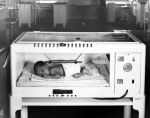
The two most experienced  nursery nurses grabbed two sterile newborn kits (these had sterile towels, washclothes, blankets, cotton balls, cord clamp, and a sterile shirt  etc..) and a few other supplies needed to care for the babies… opened the lid of the 2 Armstrong heaters and threw everything inside. —These old heavy metal heated units would open from the top and were on small little wheels. We usually used them to transport smaller babies from the delivery room to the nursery. They were already old back then and were not real easy to push.

Armstrong Incubator/Transporter

Armstrong Incubator/Transporter

This all happened very fast in a couple minutes. They were gone….headed down the elevator wearing their cover gowns pushing those old heated units filled with supplies. 

I stayed behind with a couple other nurses to watch our other patients. We watched from the window over looking the street.

Both nurses, running on short chubby legs were pushing those Armstrong Heaters down towards the street. (Think Danny DeVito and John Belushi in scrub dresses and nurses caps!).

One of the general surgeons had just come out of the hospital, saw what was happening and ran ahead of them right out into the middle of the busy street, held up both her hands to STOP all traffic. (Think Jane Fonda in a lab coat!)  If she had a whistle–she would have used it. From my window it seemed like the Keystone Cops

They got into the office, huffing and puffing. They told me there were a lot of people already in the tiny exam room. Dr.B had already delivered 0ne squalling baby girl probably about 4 lbs, about 4 or 5 weeks early.  She was pink with a lusty cry.  Dr. B was always so calm.. he was telling everyone to calm down while he tried to explain to the mother and the very faint shocked looking father that there was ANOTHER baby coming! Remember this was her first visit to our doctors? Turns out, this was her first prenatal visit ANYWHERE!!  You see….although Dr. B had told his nurses to call over to us a few minutes earlier with his findings, things happened so fast there in the office that he hadn’t QUITE really explained it yet to the parents. Twins were often a surprise in those days anyway, but this poor mom and dad had really just arrived in this country, let alone get in the door of the doctors office and promptly have TWINS!. 

Back to the delivery. The second baby was coming frank breech. No worries, we did that all the time. They told me Dr. B asked the labor nurse who had arrived first to open up one of the sterile packs and use one of the sterile towels to help hold the baby’s feet while he skillfully delivered the arms & then head of the second squalling 4 lb baby girl! The 2 nursery nurses wrapped up the babies in the sterile towels and wisked them both right out of there in the Armstrongs, out of the office, back to the street. (I doubt they let the mother have any time with the babies. That’s how it was then…… 😦 )  Like a well rehearsed skit, our lovely lady surgeon was waiting and once again— held up traffic so the nurses and babies crossed quickly and safely.  

I watched them coming back up the sidewalk and was waiting as they got off the elevator. They asked me to then help start the admission procedures in the isolation nursery. (They were born in that “dirty” office under unsterile conditions afterall!) At that time, babies delivered outside the “sterile” hospital were always watched in the Isolation Nursery. 

The mom came over by ambulance up to the delivery room to deliver her placenta (one placenta- they were indeed confirmed identical). The father was scrubbed up, gowned up and finally allowed to really see his little baby girls. I was the one to bring him over to the heaters. He was crying so hard. He was really in a state of shock and so emotional.007 I thought he was so shocked from the surprise of twins and the burst of frenzied excitement the birth had been……

This is when he told me that one year ago, in their country, his wife had suffered thru the birth of a stillborn baby girl ……… and now they had TWO healthy baby girls!!!  Can you imagine??

This family continued to grow as they stayed in town, both studying at the university. Her next baby was 10 LBs and born by C/S….. that’s another story.